






























Key Points
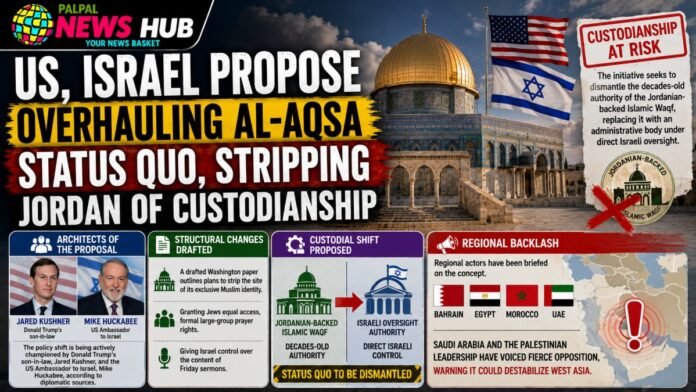
- Custodianship at Risk: The initiative seeks to dismantle the decades-old authority of the Jordanian-backed Islamic Waqf, replacing it with an administrative body under direct Israeli oversight.
- Architects of the Proposal: The policy shift is being actively championed by Donald Trump’s son,in, law, Jared Kushner, and the US Ambassador to Israel, Mike Huckabee, according to diplomatic sources.
- Structural Changes Drafted: A drafted Washington paper outlines plans to strip the site of its exclusive Muslim identity, granting Jews equal access, formal large group prayer rights, and giving Israel control over the content of Friday sermons.
- Regional Backlash: While regional actors like Bahrain, Egypt, Morocco, and the UAE have been briefed on the concept, Saudi Arabia and the Palestinian leadership have voiced fierce opposition, warning it could destabilize West Asia.
A leaked diplomatic draft has revealed that the United States and Israel are actively collaborating on a sensitive plan to fundamentally restructure the management of Jerusalem’s most flashpoint holy site. The initiative, spearheaded by President Donald Trump’s son-in-law, Jared Kushner, and heavily promoted by US Ambassador to Israel, Mike Huckabee, intends to permanently strip the Hashemite Kingdom of Jordan of its historic custodianship over the Al Aqsa Mosque complex.
Under the proposed guidelines, the Islamic Waqf Council, which has administered the compound’s internal affairs for nearly a century, would see its executive authority dismantled. In its place, the Israeli government would establish a brand-new administrative framework tasked with redesigning the compound into a “multi-faith center” open to all three Abrahamic religions.
“The administration would like to see the Al,Aqsa Mosque turned into a landmark tourist attraction,” noted officials familiar with the drafted paper, adding that the document explicitly outlines a desire to alter the strictly Islamic identity of the site.
Breaking the 1967 Status Quo: Prayer and Sermon Censorship
The core framework of the Kushner-Huckabee proposal represents an absolute departure from the traditional “Status Quo” agreement established following the 1967 war. Under that long-standing international arrangement, Israel maintains exclusive control over external security and perimeter access, while the Jordanian-appointed Waqf retains total autonomy over internal religious practices and administration.
| Regulatory Parameter | Current Status Quo Framework | Proposed US-Israeli Framework |
|---|---|---|
| Primary Administrator | Jordanian-backed Islamic Waqf Council | Israeli Government-created state body |
| Jewish Access and Rights | Non-Muslim visits allowed; prayer prohibited | “Equal access” granted; large-group prayer authorized |
| Clerical Appointments | Managed exclusively by Amman / Waqf | Israel holds veto/selection power over Imams |
| Religious Content | Independent Friday sermons | Israel signs off on sermon transcripts |
Beyond authorizing large-scale, coordinated Jewish prayer groups on the plateau, the new framework would grant the Israeli state unprecedented regulatory authority over Islamic clerics. This includes a direct, binding say in the formal appointment of Imams, preachers, and senior mosque officials, alongside an active review mechanism to monitor and modify the political and religious content delivered during Friday sermons.
Regional Resistance and the Threat of West Asian Escalation
The revelation of the plan has triggered intense diplomatic panic across West Asia, threatening to intersect dangerously with ongoing regional security frictions. The Hashemite Royal Family of Jordan, which has held the custodianship since 1924, a role formally codified in the 1994 Jordan-Israel Peace Treaty, views the proposal as a direct violation of international law and sovereign agreements.
Amman is already moving to mobilize a defensive regional coalition. While the US has reportedly briefed Abraham Accords partners, including the UAE, Bahrain, and Morocco, alongside Egypt, on the outline, the plan has encountered a massive roadblock in Riyadh.
Gulf diplomatic sources confirm that Saudi Arabia has firmly rejected the proposal, warning Washington that any attempt to forcibly change the legal status of Al Aqsa could completely rupture ongoing security negotiations and ignite a massive wave of instability across the Muslim world. Concurrently, the Palestinian leadership has issued an absolute condemnation, calling the draft a declaration of cultural and religious war.