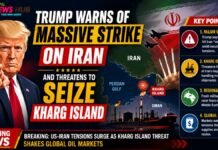

































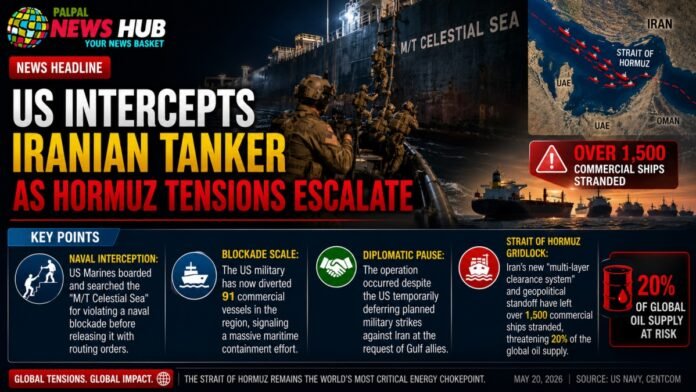
Key Points
- Naval Interception: US Marines boarded and searched the “M/T Celestial Sea” for violating a naval blockade before releasing it with routing orders.
- Blockade Scale: The US military has now diverted 91 commercial vessels in the region, signaling a massive maritime containment effort.
- Diplomatic Pause: The operation occurred despite the US temporarily deferring planned military strikes against Iran at the request of Gulf allies.
- Strait of Hormuz Gridlock: Iran’s new “multi-layer clearance system” and geopolitical standoff have left over 1,500 commercial ships stranded, threatening 20% of the global oil supply.
Tensions between the United States and Iran in the Middle East have once again reached a critical juncture. On Wednesday, U.S. forces boarded an Iranian-flagged oil tanker in the Gulf of Oman and conducted a thorough search of the vessel. According to U.S. Central Command, the tanker was speeding toward an Iranian port in direct violation of an active naval blockade. Marine commandos from the 31st Marine Expeditionary Unit intercepted the massive tanker, identified as the “M/T Celestial Sea”, while it was at sea.
After boarding the massive vessel, which measures approximately 120 meters in length, U.S. troops carried out an intensive search operation before releasing it. While the ship itself was released, its crew was issued strict orders to immediately alter their course. The United States has made it clear that it is maintaining close surveillance on vessels linked to Iran within the Strait of Hormuz and the surrounding maritime regions. To date, the U.S. has diverted the routes of a total of 91 commercial vessels, a move that constitutes a significant military operation.
US Intercepts Tanker After Announcing Deferral of Military Strikes
This stern action comes at a time when the United States had claimed to have called off planned military strikes against Iran. Following specific requests from Gulf nations, military action has currently been deferred, and diplomatic channels for dialogue remain open. On the other hand, Iran appears to be in no mood to back down at any cost and is actively making full preparations.
The Iranian Revolutionary Guards have issued a stark warning: should the United States or Israel launch any fresh attacks, the ensuing fierce conflict could spill beyond the confines of the Middle East, leading to severe and far-reaching consequences. Furthermore, Iran is rapidly working on implementing new mechanisms to further consolidate its military control over the Strait of Hormuz.
Iran’s New “Multi-Layer Clearance System”
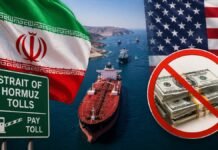
Tehran is now strictly enforcing a “multi-layer clearance system” for all vessels transiting through the region. Under this system, special permits and reportedly hefty “fees”, are being mandatorily exacted from certain vessels. The United States has warned all nations and shipping companies against complying with this control mechanism established by Iran.
Iran is now devising a new strategy for the Strait of Hormuz, acting not in isolation but in collaboration with Oman. Both nations are striving to establish a comprehensive “Sustainable Security Mechanism” for maritime vessels in the region. However, many countries and companies grappling with the energy crisis are actively seeking alternative, secure routes, even at the cost of undertaking significant risks.
A Major Global Crisis in Oil Supply
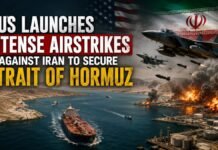
The Strait of Hormuz is regarded as one of the world’s most critical and vital maritime arteries for oil supply. Approximately 20 percent of the global daily supply of oil and gas traverses exclusively through this specific waterway. According to U.S. estimates, more than 1,500 commercial vessels from nearly 90 nations are currently stranded in the Persian Gulf.
Following the escalation of intense tensions between the U.S., Israel, and Iran in February, maritime traffic in the region had come to a near-total standstill. The stranding of vessels in the Persian Gulf has exerted upward pressure on global prices for crude oil and natural gas. The entire world is now watching closely to see whether this standoff in the Strait of Hormuz will spiral into a major military conflict.