
































Key Points
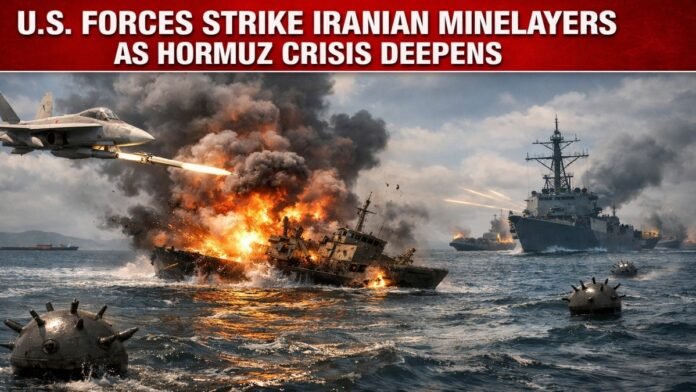
- Military Strike: U.S. Central Command confirmed the destruction of 16 Iranian mine-laying vessels near the Strait of Hormuz during “Operation Epic Fury.”
- Trade Paralysis: Commercial shipping through the Strait has plummeted by 97%, effectively creating a blockade that has halted the flow of nearly 20 million barrels of oil per day.
- Trump’s Ultimatum: The President warned Tehran of consequences “twenty times harder” than previous strikes if the waterway is not cleared immediately.
- Market Volatility: Oil prices, which peaked near $120, have shifted to $87.80 following news of potential G7 and IEA emergency stockpile releases.
- Regional Impact: While Saudi Arabia and the UAE utilize bypass pipelines, nations like Kuwait and Qatar remain entirely dependent on the now-restricted route.
On Tuesday, March 10, 2026, the U.S. military launched a targeted strike against Iranian naval assets, specifically targeting vessels suspected of secretly mining the Strait of Hormuz. President Donald Trump initially announced the destruction of 10 “inactive” boats via Truth Social, a figure later revised to 16 by CENTCOM. The operation utilized high-precision technology, previously deployed in counter-narcotics missions in the Caribbean, to “permanently eliminate” the threat to commercial navigation.
U.S. officials maintain that while Iran’s primary naval fleet has sustained heavy damage, Tehran retains a significant number of small, agile boats capable of deploying sea mines. This “Death Valley” scenario has forced major shipping conglomerates to withdraw from the region, citing skyrocketing insurance premiums and the high risk of kinetic attacks.
The Global Energy Standoff
The effective closure of the Strait has sent shockwaves through the global economy. Approximately 25% of the world’s seaborne oil and a significant portion of liquefied natural gas (LNG) pass through this narrow passage. For landlocked Gulf producers like Kuwait, the lack of alternative export routes has brought local production to a near standstill.
In response, the G7 and the International Energy Agency (IEA) held emergency talks in Paris to discuss the release of up to 400 million barrels from strategic reserves. This potential intervention, described by analysts as a “temporary shield,” aims to stabilize prices and prevent a localized conflict from triggering a global recession.
Security Cordon and Future Outlook
Despite the military’s success in neutralizing minelayers, the White House clarified that the U.S. Navy has not yet begun a formal escort program for commercial tankers. President Trump has urged shipping companies to “show some guts,” suggesting that the path is safer than perceived following the destruction of the Iranian vessels.
However, maritime intelligence reports indicate that only Iranian-flagged ships or Chinese-linked vessels are currently attempting the transit. Until a comprehensive de-mining operation is completed and security is guaranteed, the global supply chain remains at the mercy of the escalating “Operation Epic Fury,” leaving the future of petrol and diesel prices in a state of high uncertainty.
Would you like me to monitor the G7’s decision on the strategic oil release or provide a deeper dive into the specific military tech being used in the Strait?