

































Key Points
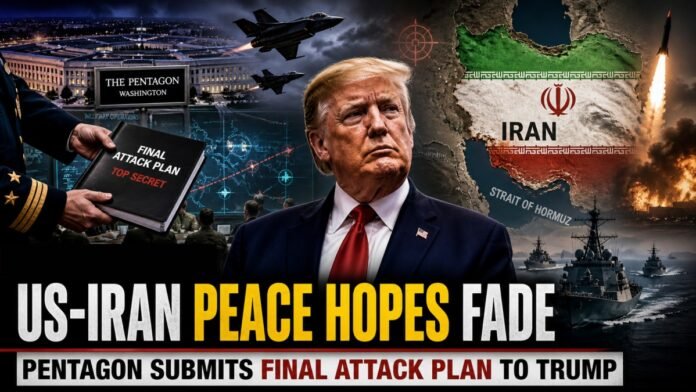
- Military Escalation: The Pentagon has officially submitted a final strike plan to the White House, fueling fears that the April 8 ceasefire is over.
- Zero Trust: IRGC official Mohammad Jafar Asadi declares that Iran maintains “not an ounce of trust” in President Trump’s administration.
- Peace Deal Rejected: The Trump administration has dismissed Tehran’s latest peace proposal, mediated by Pakistan, labeling it insufficient.
- Nuclear Red Line: President Trump reiterated that the U.S. will not allow nuclear assets to be controlled by “madmen,” signaling a hardline stance on Iran’s nuclear program.
- High Alert: Iranian forces are mobilized across the Gulf, warning of a “crushing response” to any American military maneuver.
The fragile peace established in early April is on the verge of shattering as the United States and Iran move closer to a renewed military confrontation. According to senior defense sources, the Pentagon has formally submitted a “final operational plan” for potential strikes against Iranian targets to President Donald Trump, a move that has sent shockwaves through global energy markets and regional capitals.
A Breakdown in Diplomacy
The latest escalation follows the failure of a “new proposal” for a nuclear deal sent by Tehran via Pakistani intermediaries. While Iran presented the document as a major concession to avert a “Great War,” the Trump administration dismissed the terms as inadequate. President Trump, speaking from Florida, signaled that his administration remains unconvinced by Tehran’s fractured leadership, suggesting that the Iranian government is divided into competing factions that cannot be trusted to uphold a long-term treaty.
“We cannot allow nuclear weapons to fall into the hands of madmen,” Trump stated, adding that any deal must include the total dismantling of Iran’s nuclear infrastructure and a permanent end to its regional proxy influence.
Tehran’s “Retaliatory Stance”
In response to the U.S. military posturing, Iran’s military command has adopted a posture of total readiness. Brigadier General Mohammad Jafar Asadi, a high-ranking military official, spoke through the Fars News Agency to express Iran’s deep skepticism of American intentions. Asadi asserted that Washington has abandoned the “path of reason” and is more concerned with manipulating global oil prices and its own international image than with achieving a just peace.
“We do not place even the slightest shred of trust in President Trump,” Asadi said, warning that any “misstep” by U.S. forces would be met with a response meant to “decimate” American assets in the region.
Strategic Context and the “Final Plan”
The submission of the Pentagon’s final operational plan marks a critical turning point. While the U.S. successfully neutralized significant portions of Iran’s conventional Navy and Air Force during the 60-day conflict window between February and April, intelligence suggests Tehran has worked to reorganize its remaining missile batteries and drone swarms.
The Pentagon’s plan reportedly includes contingencies for a final, large-scale strike using B-2 stealth bombers to target deeply buried facilities that may have survived previous sorties. This military maneuvering comes amid a backdrop of domestic political noise in the U.S., where President Trump has labeled critics of his hardline policy as “traitors” while concurrently navigating controversies surrounding political opponents in Congress.
Regional Impact: Oil and Uncertainty
As the April 8 ceasefire falters, the Middle East remains a powder keg. The United Arab Emirates and Israel, key U.S. allies in the region, remain on high alert following the covert deployment of advanced defensive systems like the Iron Beam. Analysts warn that if a consensus cannot be reached in the coming days, the region could revert to a state of total war, potentially disrupting the Strait of Hormuz and causing a global economic crisis. For now, the world watches the White House, waiting to see if President Trump will authorize the Pentagon’s final plan or leave the door open for a final hour of diplomacy.