

































Key Points
- Digital Window: Online self-enumeration is available via the official portal from May 1 to May 15, 2026.
- Physical Verification: A massive force of 50,000 government enumerators will conduct house, to, house visits from May 16 to June 14.
- Simplified Process: Residents can complete the 33-question digital form in approximately 15 to 20 minutes.
- Tenant Inclusion: For the first time, tenants are encouraged to independently register using their own mobile numbers.
- Data Security: All submitted information is encrypted and legally protected from use in police investigations or RTI inquiries.
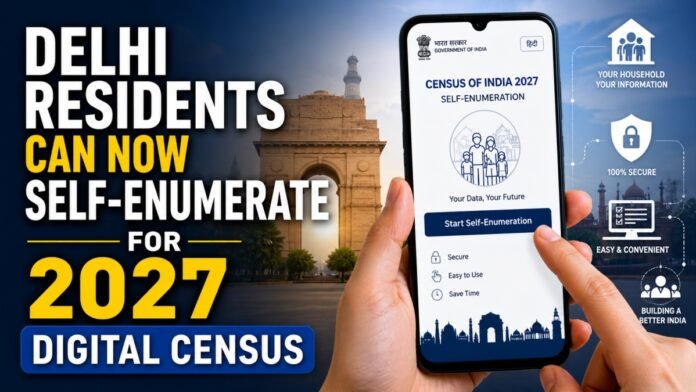
In a landmark step toward the modernization of national data collection, the Delhi government has initiated the first phase of Census 2027. This exercise, which focuses on Houselisting and Housing Operations (HLO), marks India’s transition to a fully digital enumeration system. Residents across all 250 municipal wards in the capital now have until May 15 to utilize the self-enumeration facility, a move designed to reduce errors and accelerate the overall process.
Chief Minister Rekha Gupta and Lieutenant Governor Taranjit Singh Sandhu lead the campaign by completing their own self-enumeration on Friday. Officials emphasize that this digital-first approach empowers citizens to submit household details directly, ensuring that every resident is accurately counted without the need for lengthy manual interviews.
The Self, Enumeration Guide
The government has streamlined the digital process into a user-friendly interface accessible at [https://se.census.gov.in](https://se.census.gov.in). To participate, residents must follow a structured series of steps:
- Registration: Users log in by selecting “Delhi” and entering a unique mobile number for the household.
- Verification: Identity is verified through a One-Time Password (OTP) sent via the official “RGICEN” sender ID.
- Mapping: For the first time, residents will pinpoint their exact home location on a digital map, facilitating more accurate geo,tagging for urban planning.
- Completion: After answering the mandatory questionnaire, users receive an 11, digit Self, Enumeration ID (SE ID) starting with the letter ‘H’.
This SE ID is a critical document that must be shared with government officials during the physical verification phase to confirm the digital entry.
A Comprehensive 33-Question Survey
The census questionnaire is exhaustive, consisting of 33 mandatory questions that cover the physical and social profile of the household. Beyond basic demographics, the survey collects data on:
- Building Material: The predominant material used for floors, walls, and roofs.
- Ownership Status: Whether the house is owned, rented, or used for commercial purposes.
- Amenities: Access to drinking water, electricity, LPG connections, and internet facilities.
- Assets: Ownership of bicycles, scooters, or cars.
A significant change in this census is the empowerment of tenants. Previously reliant on homeowners for registration, tenants are now required to use their own mobile numbers to provide details of their current residence. This ensures a more granular and accurate representation of Delhi’s transient and migrant populations.
Logistics and Privacy Safeguards
While the digital window is open for 15 days, the government is preparing for the second stage of the operation. Starting May 16, approximately 50,000 teachers and government staff will begin a month, long door,to, door campaign. These enumerators will visit every household to collect data from those who did not self-enumerate and to validate the SE IDs of those who did.
To address concerns regarding data privacy, the Office of the Registrar General has clarified that census information is strictly confidential. Under current laws, census data is encrypted on secure government servers and cannot be used as evidence in a court of law or accessed through Right to Information (RTI) requests. As the capital moves toward this digital future, officials urge all residents to complete their forms promptly to avoid logistical hurdles during the physical survey period.