
































Key Highlights
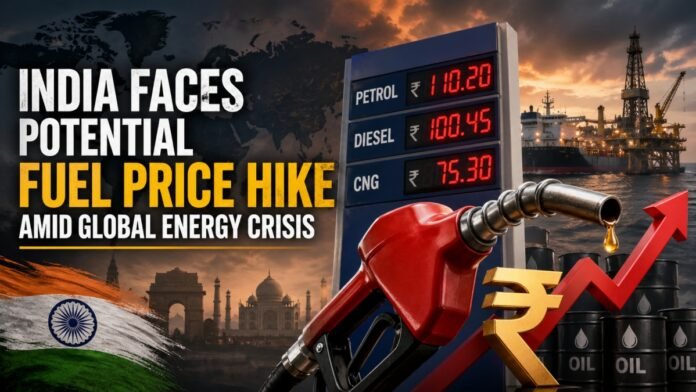
- Imminent Hike: Ministry of Finance report suggests a domestic fuel price increase is “unavoidable” following global surges.
- Strategic Imports: India received 2 million barrels of Iranian crude in Gujarat, the first such purchase in seven years.
- OMC Losses: State-run oil companies reported daily losses of ₹2,400 crore throughout March 2026.
- Market Projections: Analysts predict a price jump ranging from ₹8 to ₹35 per liter depending on global crude stability.
- Economic Ripple: Rising fuel costs threaten to push India’s inflation toward 4.7% by 2027 and accelerate EV adoption.
The escalating military and diplomatic standoff between the United States and Iran has pushed the global energy crisis to a breaking point. While neighboring nations such as Pakistan, Bangladesh, and Sri Lanka are already grappling with skyrocketing oil costs, India has managed to maintain a precarious price stability. However, this period of domestic calm may soon end. On April 29, 2026, the Ministry of Finance released a pivotal report indicating that the government can no longer fully insulate the public from the rising cost of international crude, which India is currently procuring at an average of $113 per barrel.
Political Debate and the “Election Pause”
The timing of the potential hike has drawn sharp criticism from opposition leaders. Rahul Gandhi, Leader of the Opposition, previously claimed that the price freeze observed during recent assembly elections was a temporary political maneuver. He argued that the government prioritized political optics over fiscal transparency, predicting that a sharp upward correction would occur immediately after April 29.
History supports this pattern of “electoral pauses.” Fuel prices remained static ahead of major elections in 2014, 2019, and several state polls between 2020 and 2022, only to be revised upward once the voting concluded. As of May 1, 2026, the industry is closely watching to see if the government will follow this historical precedent.
Diversifying the Energy Basket, Russia and Iran
To mitigate the impact of West Asian supply disruptions, India has diversified its sourcing. While Saudi Arabia and the UAE remain primary suppliers, providing 80% to 85% of requirements, India has utilized U.S. sanctions exemptions to tap into Russian and Iranian markets.
Notably, India recently finalized a deal for 4 million barrels of Iranian crude, marking its first significant purchase from Tehran in seven years. Two tankers carrying 2 million barrels have already arrived at Gujarat ports. Despite these efforts, the high cost of procurement continues to drain the resources of state-run Oil Marketing Companies (OMCs) like IOCL, BPCL, and HPCL. These entities reported massive losses in March, estimated at ₹2,400 crore daily, as they absorbed costs to keep retail prices steady.
Projected Price Hikes and Economic Impact
Financial institutions have offered varying forecasts for the coming weeks:
- Macquarie Group: Projects a hike of ₹18 for petrol and ₹35 for diesel.
- Kotak Institutional Equities: Foresees an increase between ₹25 and ₹28.
- Standard Chartered: Estimates a more moderate rise of ₹8 to ₹15 if crude stabilizes near $95.
While Sujata Sharma, Joint Secretary at the Ministry of Petroleum, has dismissed these figures as speculative and assured the public of adequate reserves, the Ministry of Finance’s own report suggests a shift is looming.
The consequences of such a hike extend far beyond the fuel pump. With 70% of India’s freight moved by road, an increase in diesel prices will directly inflate the cost of essential commodities, including fruits, vegetables, and grains. Economists warn that persistent high energy costs could drive India’s inflation rate to 4.7% by 2027. On a transformative note, experts suggest these high prices may act as a catalyst for green energy, potentially increasing electric vehicle (EV) adoption by 20% to 25% as consumers seek relief from fossil fuel volatility.