
































Google CEO
Key Highlights
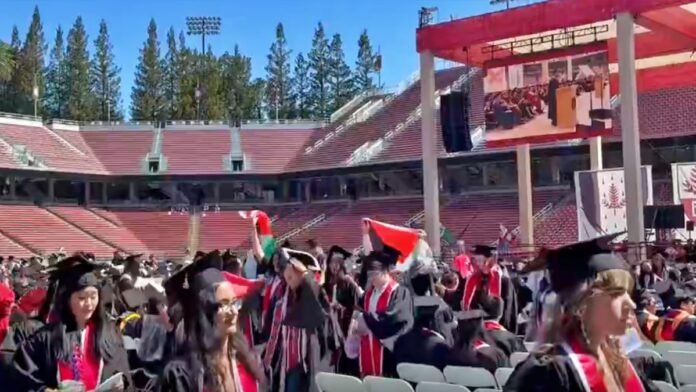
- Graduation Walkout: Over 100 graduating students walked out of Stanford Stadium as Pichai took the stage, chanting pro-Palestinian slogans.
- Project Nimbus Opposed: Activists protested Google’s involvement in Project Nimbus, a 1.2 billion dollar cloud and AI contract with the Israeli government.
- Tech Talk Avoided: Despite expectations, Pichai largely steered clear of artificial intelligence, centering his address instead on personal optimism and resilience.
- No Direct Response: Pichai did not acknowledge the demonstration during his speech and later declined to comment when questioned by journalists.
Stanford University’s 135th commencement ceremony on Sunday, June 14, 2026, took an unexpected political turn when Google and Alphabet CEO Sundar Pichai faced a coordinated student protest. Moments after Pichai was introduced to deliver the keynote address at Stanford Stadium, a sizable group of graduates stood up from their seats, waved Palestinian flags, blew whistles, and began chanting slogans, including “Free, free Palestine,” before walking out of the venue.
The demonstration, organized by campus activist coalitions including Students for Justice in Palestine and No Tech for Apartheid, briefly escalated tensions within the stadium. Faculty, families, and thousands of attendees looked on as more than 100 students in graduation gowns and caps filed out of the seating area in protest of major tech companies’ ties to defense and government contracts.
The Core of the Dissent: Project Nimbus
The primary catalyst for the campus demonstration is Google’s controversial involvement in Project Nimbus. Valued at approximately 1.2 billion dollars, Project Nimbus is a joint cloud computing and artificial intelligence framework awarded to Google and Amazon by the Israeli government.
Student organizations and various global human rights groups have repeatedly voiced sharp criticism over the deal, alleging that the provided cloud infrastructure and advanced technology assist the Israeli military and government operations. Campus discontent regarding the corporate partnership has intensified significantly over recent months, mirroring broader anti-war and tech-accountability movements across major American universities.
Pichai Steers Speech Toward Optimism and Resilience
Despite the high-profile disruption, the graduation program proceeded as planned. Pichai, a Stanford alumnus who earned his master’s degree from the university in 1995, delivered a measured address that notably shifted away from corporate tech updates or deep dives into artificial intelligence, a topic that has drawn heavy scrutiny at other recent public forums.
Instead, Pichai focused his remarks on life lessons and navigating professional uncertainty, advising the Class of 2026 to embrace a positive framework. “Choose optimism,” Pichai told the graduating class. “It’s easy to look at the news of the day and think that we’re living in uniquely challenging times. For me, it’s helpful to remember that each generation has faced hardship in their own way. We don’t get to choose the world we graduate into, but we do get to choose how we frame our circumstances.”
Rejection of Comments Following the Event
The tech executive did not directly address the demonstrating students or the chants echoing from the stands during his keynote presentation. Following the conclusion of the ceremony, a BBC journalist approached Pichai as he exited Stanford Stadium, asking if he had any reaction to the day’s protests. Pichai declined to answer, turning away to continue walking without providing a comment.
Neither Google nor Stanford University administration has released official post-event statements regarding the walkout. The incident underscores a growing wave of campus activism where entry-level professionals and students increasingly interrogate the ethical boundaries of major technology firms and their global state partnerships.