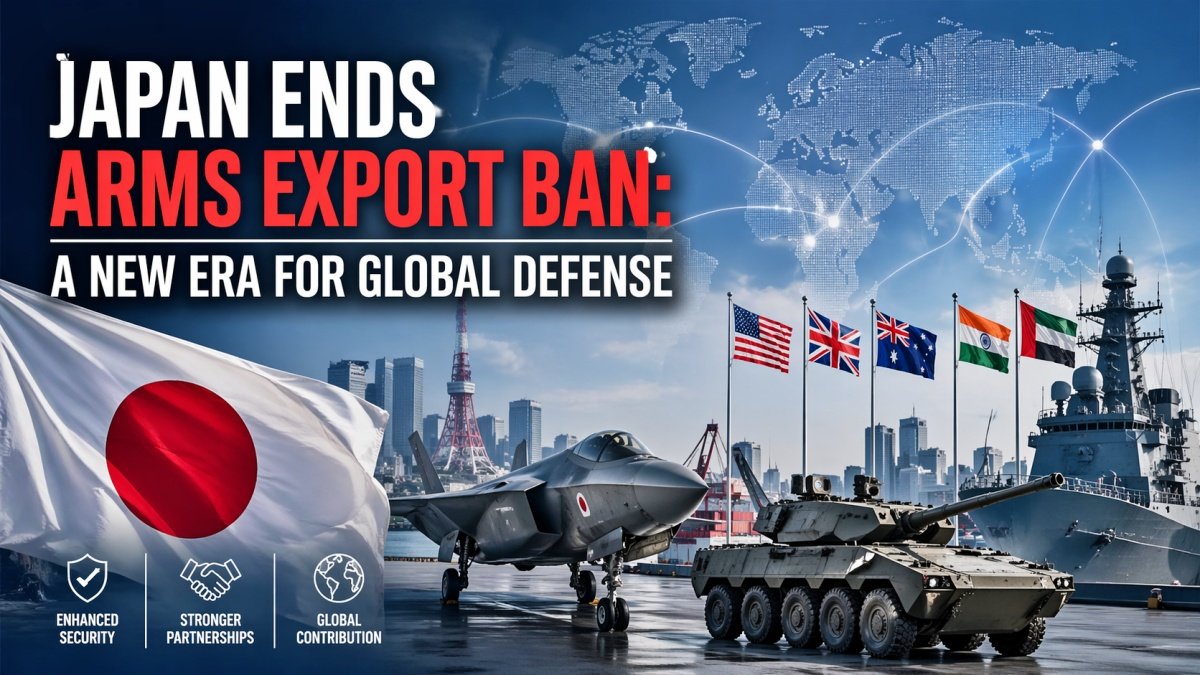
Key Highlights
- Historic Policy Reversal: The Cabinet has formally ended a nearly 50-year restriction on exporting lethal defense equipment.
- Advanced Tech for Sale: Japan is now eligible to export next-generation fighter jets, missiles, and naval vessels.
- Strategic Safeguards: Sales are limited to nations that strictly adhere to the UN Charter and maintain bilateral defense pacts with Tokyo.
- Economic Impact: The move is expected to revitalize Japan’s domestic aerospace and defense sectors, providing a new pillar for industrial growth.
The global defense landscape is experiencing a significant transformation as Japan, a nation that has maintained a strictly pacifist stance since 1945, enacts a revolutionary shift in its military policy. The administration of Prime Minister Sanae Takaichi has moved to dismantle the 1967 “Three Principles” on arms exports, which for decades limited Japan to selling only non-lethal equipment.
Under this new framework, Tokyo is positioning itself as a major player in the international arms market. This transition is not merely economic but is a direct response to a deteriorating security environment in East Asia. Prime Minister Takaichi emphasized that in an era defined by rapid technological advancement and rising regional tensions, isolationism is no longer a viable path to peace. By commercializing its defense capabilities, Japan aims to strengthen its domestic industrial base while deepening security ties with like-minded democratic allies.
Expanding the Arsenal: Fighter Jets and Naval Power
Previously, Japan’s defense exports were confined to “grey zone” equipment, such as radar systems, patrol boats, and minesweeping tools. The new regulations permit the export of sophisticated offensive platforms. Most notably, this includes Japan’s contributions to the Global Combat Air Programme (GCAP), a joint venture to develop a sixth-generation stealth fighter.
By allowing the export of these jets, Japan ensures it remains a central hub for aerospace innovation. Furthermore, the Japanese government has signaled an increased willingness to collaborate on naval architecture. Recent diplomatic discussions suggest that Japan is exploring a landmark deal to provide advanced warship designs and components to Australia, which would directly challenge the market dominance of traditional exporters like the United States and European nations. Japanese technology, known for its extreme precision and reliability, is expected to provide a high-tier alternative to equipment currently offered by Russia or China.
Global Eligibility and Ethical Constraints
Japan has remained firm that it will not become an “indiscriminate” arms dealer. The Takaichi administration has established a rigorous vetting process to ensure that exported technology is not used to violate international law. Currently, approximately 17 nations meet the preliminary eligibility criteria, based on their existing defense cooperation agreements with Tokyo and their commitment to the United Nations Charter.
These nations, which include key partners in the Indo-Pacific and Europe, must pledge that any Japanese-made lethal equipment will be used strictly for self-defense or international peacekeeping operations. As Japan continues to sign new bilateral security treaties, this list of eligible buyers is expected to grow, further integrating Japan into the global security architecture.
Overturning the 1967 Legacy
The original 1967 regulations, which were tightened in 1976 to create a virtual “blanket ban” on lethal exports, effectively sidelined Japan’s defense industry for half a century. While this ensured a peaceful international image, it also left Japan’s defense contractors, such as Mitsubishi Heavy Industries and Kawasaki, heavily reliant on a single customer: the Japanese Self-Defense Forces.
The removal of these barriers, completed in early 2026, allows Japan to achieve better economies of scale, reducing the cost of its own defense procurement while simultaneously projecting power through diplomacy. This shift signals that Japan is no longer a silent observer in global security matters, but a decisive force shaping the future of international defense cooperation.