



































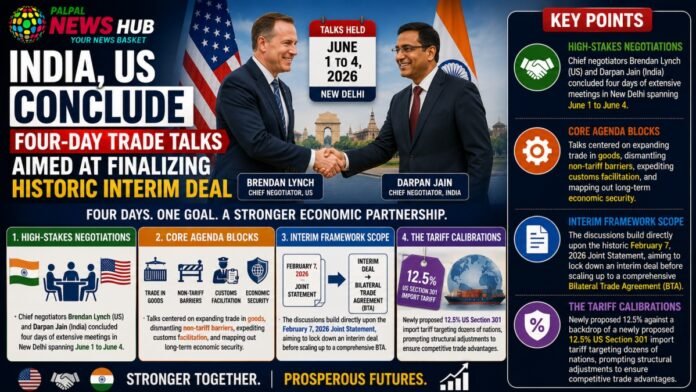
Key Points
- High-Stakes Negotiations: Chief negotiators Brendan Lynch (US) and Darpan Jain (India) concluded four days of extensive meetings in New Delhi spanning June 1 to June 4.
- Core Agenda Blocks: Talks centered tightly on expanding trade in goods, dismantling non-tariff barriers, expediting customs facilitation, and mapping out long-term economic security.
- Interim Framework Scope: The discussions build directly upon the historic February 7, 2026 Joint Statement, aiming to lock down an interim deal before scaling up to a comprehensive Bilateral Trade Agreement (BTA).
- The Tariff Calibrations: The engagement occurs against a backdrop of a newly proposed 12.5% US Section 301 import tariff targeting dozens of nations, prompting structural adjustments to ensure competitive trade advantages.
Bilateral commerce between the world’s largest and fifth-largest economies marked notable progress as a high-level delegation from the Office of the United States Trade Representative (USTR) concluded a historic four-day visit to New Delhi. Led by US Chief Negotiator Brendan Lynch and matched by India’s Chief Negotiator Darpan Jain, Additional Secretary in the Department of Commerce, the sessions ran from June 1 through June 4.
The primary objective of these consultations remains the rapid execution of a robust interim trade agreement. According to an official statement issued by India,s Ministry of Commerce and Industry, the engagement demonstrated an elevated spirit of strategic cooperation and pragmatism. Delegations conducted granular reviews of prior negotiating rounds, targeting remaining issues that Indian Commerce Minister Piyush Goyal recently characterized as minor adjustments, describing them as resolving remaining “commas and full stops.”
Deepening Trade Parameters and Structural Frameworks
The comprehensive talks delved into vital, technical components governing cross-border commerce, including:
- Trade in Goods and Market Access: Recalibrating import-export mechanisms across industrial and agricultural segments.
- Non-Tariff Measures: Systematically identifying and removing regulatory bottlenecks, specifically addressing historic concerns regarding medical device imports and restrictive licensing rules.
- Customs and Trade Facilitation: Streamlining border clearances and optimizing economic security coordination across supply lines.
This intensive round follows an April session held in Washington, DC, and operates under a structured template set by both nations during their landmark joint statement on February 7, 2026. The initial phase features aggressive market expansion proposals, including New Delhi’s intention to eliminate or slash tariffs on US industrial goods and key agricultural products like tree nuts, fresh fruits, and soybean oil. Furthermore, India has expressed a blueprint to purchase $500 billion worth of US energy, commercial aircraft, tech infrastructure, and coking coal over a five-year horizon.
Geopolitical Intersect: Section 301 Probes and Global Alignments
The progression toward a finalized text occurs alongside critical international developments. On June 2, the USTR concluded a comprehensive Section 301 investigation regarding global forced labor import compliance, subsequently proposing a 12.5% tariff structure across 54 economies, including India. New Delhi clarified that it remains actively and constructively engaged with Washington regarding these global tariff proposals, which face a public hearing scheduled on July 7, while keeping bilateral framework talks strictly isolated on a separate, parallel track.
The ongoing recalibration of the trade pact reflects shifted realities under current international policies. Earlier this year, Washington successfully terminated a 25% ad valorem tariff on Indian goods following New Delhi’s strategic pivot to halt purchases of sanctioned Russian crude oil, replacing those volumes with imports of US energy products.
Global Business Alignment: Observers note that while competing regional markets navigate economic shifts, the evolving Washington-New Delhi axis is designed to secure reliable, resilient supply networks. This economic integration is viewed globally as a defining trade partnership of the century, expected to significantly accelerate job creation and investment in both hemispheres.