































Key Points
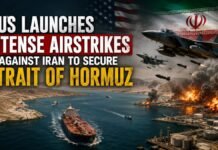
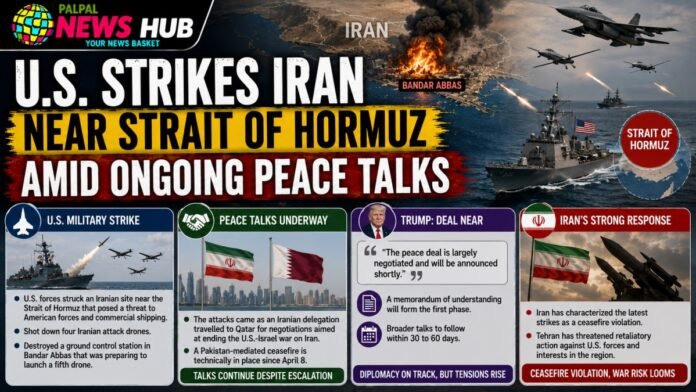
- U.S. forces struck an Iranian site near the Strait of Hormuz that posed a threat to American forces and commercial shipping, shot down four Iranian attack drones, and destroyed a ground control station in Bandar Abbas that was preparing to launch a fifth drone.
- The attacks came as an Iranian delegation travelled to Qatar for negotiations aimed at ending the U.S.-Israel war on Iran, with a Pakistan-mediated ceasefire technically in place since April 8.
- Trump has stated the peace deal is “largely negotiated” and will be announced shortly, with a memorandum of understanding forming the first phase, followed by broader talks within 30 to 60 days.
- Iran has characterized the latest strikes as a ceasefire violation and threatened retaliatory action.
U.S. Central Command stated that American forces targeted Iranian military facilities responsible for launching a series of “unprovoked” missile, drone, and small boat attacks against American warships transiting the Strait of Hormuz. The targeted facilities included missile and drone launch sites, command and control locations, and intelligence, surveillance, and reconnaissance nodes.
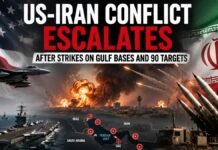
A U.S. official confirmed that strikes were carried out in multiple locations, including Bandar Abbas and Qeshm. No U.S. assets were struck in the Iranian attacks.
U.S. forces described these actions as “measured, purely defensive, and intended to maintain the ceasefire.” However, Iran disputed this characterization.
Explosions Rock Bandar Abbas
Three explosions were heard to the east of Bandar Abbas, a strategic Iranian port city and naval base near the Strait of Hormuz, prompting the activation of air defense systems in the area. Local media reported the sounds of the blasts in the early hours of the morning.
An Iranian spokesperson claimed that U.S. airstrikes hit civilian areas along the coasts of Qeshm Island, Bandar Khamir, and Sirik, and accused Washington of violating the ceasefire by targeting an Iranian oil tanker heading toward the Strait of Hormuz.
Background: A Conflict Rooted in February
The crisis erupted on February 28, 2026, when U.S. and Israeli forces launched “Operation Epic Fury” against Iranian nuclear sites and military infrastructure. Iran retaliated by declaring the Strait of Hormuz closed, deploying mines, drones, and speedboats to deter transit, halting nearly all commercial shipping and stranding over 150 tankers in the Arabian Gulf.
Until the conflict began, the Strait of Hormuz had been open, with roughly 25% of the world’s seaborne oil trade and 20% of global liquefied natural gas passing through it.
A Pakistan-mediated ceasefire was agreed upon on April 8, though it has since been violated by both sides on multiple occasions.
Peace Talks Still Moving Forward
Despite the latest flare-up, diplomatic efforts continue. Iran and the United States are negotiating a memorandum of understanding to convert their ceasefire into a lasting settlement, with key sticking points including the reopening of the Strait of Hormuz, Iran’s uranium stockpile, and billions of dollars in frozen assets.
Trump has declared the agreement “largely negotiated,” expressing confidence that a formal announcement is near. The competing pressures of active military strikes and active diplomacy have left the situation highly fluid, with the outcome of talks and the durability of any ceasefire still uncertain.