































Key Points
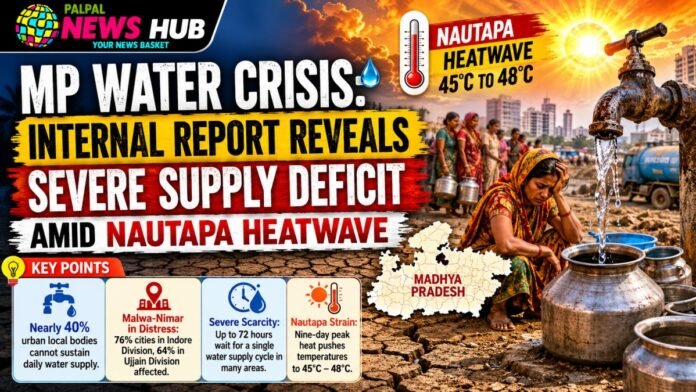
- Supply Infrastructure Deficit: A leaked Department of Urban Administration and Development document confirms that nearly 40% of the state’s urban local bodies cannot sustain a daily water supply.
- Malwa-Nimar Distress: Major economic and cultural hubs are the hardest hit, with 76% of cities in the Indore division and 64% in the Ujjain division failing to deliver daily drinking water.
- Severe Scarcity Gaps: Residents in multiple municipal areas, including industrial zones like Mandideep and Jawar, are forced to wait up to 72 hours for a single water supply cycle.
- Nautapa Climatological Strain: The structural breakdown coincides with the annual nine-day peak summer phenomenon, pushing central India’s temperatures toward the 45°C to 48°C range.
An internal assessment compiled by the Department of Urban Administration and Development has laid bare a systemic water management crisis in Madhya Pradesh. Despite successive municipal campaigns promising robust, tap-based infrastructure, the data indicate that 162 urban local bodies have officially suspended daily distribution.
The report highlights a deeply volatile rationing framework, recording eight separate urban clusters where water is released only once every three days. The crisis has penetrated deep into the Mahakaushal region, where two specific urban nodes under the Jabalpur division receive municipal supply with clear two-day gaps. Out of the 56 total urban bodies in Jabalpur, only 46 have managed to hold onto a regular 24-hour distribution loop.
Regional Breakdown: Industrial and Urban Belts Grounded
The geographical spread of the scarcity presents an alarming picture for the state’s commercial and industrial lifelines, with local administrative bodies unable to maintain basic load balances.
| Division / Zone | Affected Urban Bodies | Status of Daily Supply |
|---|---|---|
| Indore Division | 76% of municipal towns | Intermittent / Shifted to alternate days |
| Ujjain Division | 64% of municipal towns | Severe scarcity / Localized distress |
| Bhopal Division | 17 urban bodies | Alternate,day rationing implemented |
| Mandideep & Jawar | MPUDC Industrial Zones | Disrupted / One supply cycle every 3 days |
In the capital’s periphery, the Bhopal division has shifted 17 distinct administrative blocks to alternate, day rationing. The industrial corridors managed under the Madhya Pradesh Urban Development Company (MPUDC), specifically Mandideep and Jawar, have registered the sharpest drop, stepping down directly to a 72-hour rationing schedule.
Climatological Outlook Promises Further Complications
Urban planning and climate experts warn that the immediate timeline offers zero margin for structural recovery. The breakdown directly overlaps with Nautapa, the traditional nine-day meteorological window starting late May when the solar angle triggers maximum thermal absorption over central India.
With the India Meteorological Department (IMD) issuing red alerts for severe heatwave conditions across 44 districts and predicting temperatures oscillating between 45°C and 48°C, the evaporation stress on open reservoirs has spiked exponentially. Analysts stress that unless emergency administrative interventions, such as centralizing the commercial water tanker grid and initiating community-level borewell recharges, are executed on a war footing, the urban supply framework faces an imminent and absolute collapse.