
































Key Highlights
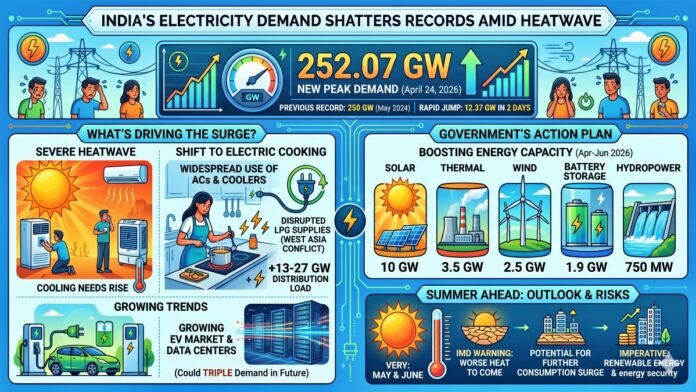
- Record-Breaking Demand: Peak power reached 252.07 GW on Friday, surpassing the previous record of 250 GW set in May 2024.
- Induction Cooking Surge: LPG supply disruptions due to West Asia conflicts have added 13,27 GW to the distribution load as consumers shift to induction stoves.
- Capacity Expansion: The Ministry of Power plans to add 22 GW of new capacity by June 2026, including 10 GW of solar and 3.5 GW of thermal power.
- Harsh Summer Forecast: The IMD warns of intensified heatwaves throughout May and June, potentially pushing demand toward the 270 GW mark.
India is currently grappling with a severe and prolonged heatwave, the impact of which has manifested as a historic surge in energy consumption. According to the latest data from the Ministry of Power, the nation’s peak electricity demand shattered all previous records this past week, hitting an all-time high of 252.07 GW on Friday, April 24, 2026. This milestone reflects a rapid escalation in consumption, as the demand stood at just 239.70 GW on April 22, representing a jump of over 12 GW in just 48 hours.
Experts point to the non-stop operation of air conditioners, desert coolers, and industrial cooling systems as the primary drivers of this spike. While the government had previously projected a seasonal peak of 270 GW, the current trajectory suggests that the grid will face its toughest test in the coming weeks as the mercury continues to climb.
The Shift to Electric Cooking and Emerging Loads
Beyond the weather, changing consumer behavior is fundamentally altering India’s energy profile. Krushna Chandra Panigrahy, Director General of the Bureau of Energy Efficiency (BEE), noted that geopolitical tensions in West Asia have significantly disrupted LPG supply chains. This has accelerated a nationwide transition toward induction-based cooking, which is estimated to be adding between 13 and 27 GW of additional demand at the distribution level.
This “gas-to-grid” shift, combined with the rapid proliferation of electric vehicles (EVs) and the expansion of AI-driven data centers, is expected to fundamentally reshape the base-load requirements of the country. Officials warn that without significant infrastructure upgrades, these emerging sectors could eventually triple current demand levels.
Government Strategy and Capacity Addition
In response to the escalating crisis, the Ministry of Power has moved to fast-track new energy projects. Piyush Singh, Additional Secretary at the Ministry, announced a strategic plan to bring over 22 GW of new capacity online between April and June 2026. The breakdown of this expansion includes:
- 10 GW of solar energy
- 3.5 GW of thermal power for grid stability
- 2.5 GW of wind energy
- 1.9 GW of battery energy storage systems (BESS)
- 750 MW of hydropower
These additions are seen as critical buffers to prevent load shedding during the peak evening hours when solar generation drops off but cooling demand remains high.
Investment Outlook and Future Risks
The ongoing energy crunch is opening massive capital expenditure (Capex) opportunities. Recent industry reports indicate that the development of a next-generation national transmission grid alone could represent a staggering $650,700 billion (approx. ₹54,60 lakh crore) investment opportunity over the coming years. This underscores the scale of the transition required to support a 1,000 GW capacity goal.
However, the immediate concern remains the short-term forecast. The India Meteorological Department (IMD) has issued warnings that heat conditions in May and June could become even more lethal. With the mercury expected to remain well above normal across northwest and central India, the nation’s energy security will depend on the successful integration of new renewables and the continued resilience of the existing thermal fleet.