Key Points
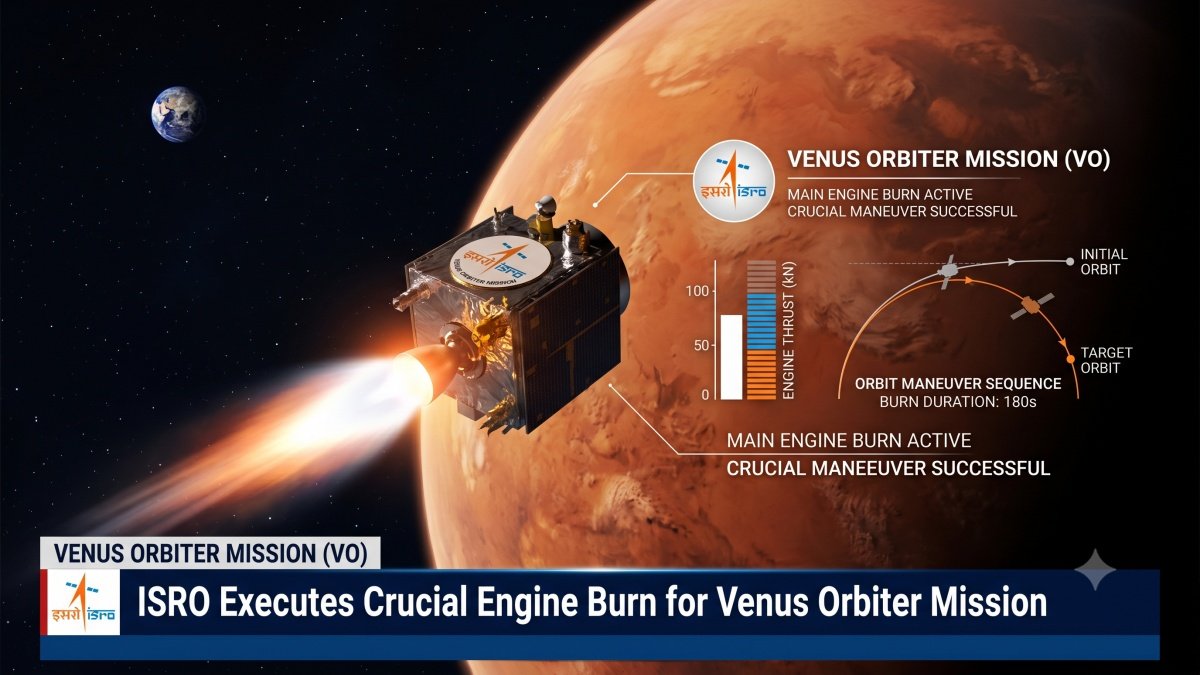
- Precision Firing: The spacecraft’s Liquid Apogee Motor fired seamlessly for exactly 42 seconds to alter velocity and secure the intended flight path.
- Radiation Correction: The maneuver countered a minor 0.04% trajectory deviation induced by continuous solar radiation pressure in deep space.
- Milestone Progress: Telemetry streams confirm the orbiter has completed 34% of its total transit distance to Venus, with all onboard subsystems functioning normally.
- Tracking Capabilities: Operations were monitored and validated in real time by the ISRO Telemetry, Tracking and Command Network in Bengaluru.
- Hostile Environment: Retired aerospace experts highlight that the vehicle faces extreme thermal management challenges and corrosive acid clouds upon approach.
BENGALURU: The Indian Space Research Organisation, or ISRO, has successfully executed a critical secondary trajectory correction maneuver for its landmark Shukrayaan Venus orbiter mission. Commencing at precisely 08:45 AM IST, the spacecraft’s primary propulsion system, the Liquid Apogee Motor, was fired for a precise duration of 42 seconds. The entire operation was managed and monitored by the ISRO Telemetry, Tracking and Command Network, known as ISTRAC, based in Bengaluru.
The successful burn accurately adjusted the vehicle’s velocity vector, ensuring its complex orbital insertion trajectory remains perfectly aligned for its upcoming arrival at Venus. At 10:10 AM IST, ISRO Mission Control issued a formal validation statement confirming the new orbital coordinates and declaring the spacecraft’s overall trajectory health as nominal. Telemetry data streamed back to Earth confirmed that all core onboard subsystems, electrical payloads, and power-generating solar arrays are continuing to perform at optimal parameters.
This precise maneuver was necessitated by solar radiation pressure, a continuous cosmic force that had induced a minimal 0.04% deviation from the spacecraft’s highly calculated flight path. While seemingly microscopic, such deviations can amplify over millions of kilometers of interplanetary travel, potentially jeopardizing the critical insertion window. This burn marks a vital milestone, as the spacecraft has now safely traversed 34% of its total transit distance to the second planet from the Sun.
The achievement heavily underscores India’s rapidly advancing deep-space navigation and tracking capabilities. Operating across vast interplanetary distances requires an ultra-precise ground station architecture. ISTRAC’s ability to ping, track, and command a fast-moving probe across millions of kilometers demonstrates global peer-level competency in deep-space exploration, joining an elite group of space agencies capable of such sophisticated navigation.
However, navigating the void of space is only the first phase of an incredibly complex mission. Retired planetary scientists from ISRO point out that the real trial begins as the spacecraft approaches its destination. Operating a vehicle near Venus introduces distinct, brutal challenges that Earth-orbiting or even lunar satellites never encounter. Venus is shrouded in a hyper-dense atmosphere of carbon dioxide and cloaked by highly corrosive sulfuric acid clouds. It experiences an extreme runaway greenhouse effect that pushes surface temperatures past 460 degrees Celsius.
Furthermore, as the spacecraft draws closer to the Sun, solar irradiance increases exponentially. Retired space scientists note that the spacecraft’s thermal management systems will be pushed to their technical limits to protect sensitive scientific payloads from being roasted by intense solar flares and reflected planetary heat. Managing these extreme thermal profiles, alongside executing a flawless aerobraking maneuver to circularize the orbit without being pulled into the crushing atmosphere, represents the pinnacle of interplanetary engineering. With more than a third of the journey complete, ISRO’s textbook engine burn brings India one step closer to uncovering the dense mysteries of Earth’s hostile twin.