Key Points
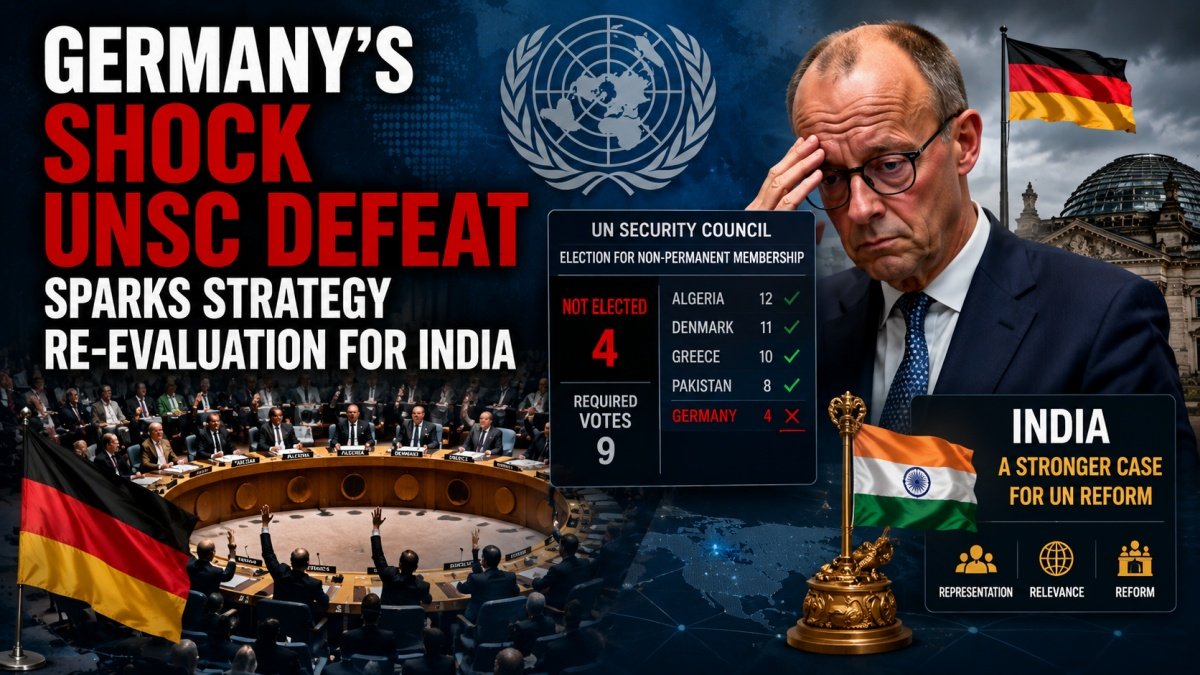
- Germany failed to secure a non-permanent UNSC seat, scoring just 104 votes against Portugal’s 134 and Austria’s 131.
- Analysts attribute Germany’s historic loss to its stance on global conflicts and a sharp decline in credibility among Global South nations.
- The defeat serves as an explicit warning for India, which faces a challenging campaign against Tajikistan for the 2028,2029 term.
- The outcome raises serious questions about whether India’s alignment with the G4 grouping has shifted from an asset to a diplomatic liability.
The geopolitical balance at the United Nations underwent a major shift during the UN General Assembly secret ballot in New York. In a fiercely contested race for the two non-permanent seats allocated to the Western European and Others Group (WEOG), Germany suffered a crushing and unprecedented defeat. Portugal secured 134 votes, and Austria claimed 131 votes, with both comfortably clearing the required two-thirds majority. Meanwhile, Germany lagged far behind with only 104 votes, breaking its historical winning streak and delivering a severe foreign policy blow to Berlin.
Former diplomats, including India’s former Permanent Representative to the UN, T.S. Tirumurti, point out that Germany’s waning global standing stems from deep foreign policy fractures. Berlin’s perceived selective multilateralism, particularly its unyielding positions on West Asian conflicts and muted responses to violations of the international rules-based order, severely alienated voting blocs within the Global South. Strong quiet resistance from permanent members like Russia and China further sealed Germany’s exit.
The Looming Challenge for New Delhi
Germany’s defeat is not just a European issue; it serves as a critical wake-up call for India. New Delhi is actively campaigning for a non-permanent seat for the 2028,2029 term, with the decisive vote scheduled for June 2027.
While older briefs often cited Kazakhstan as the primary regional competitor, updated developments from the Ministry of External Affairs reveal that India actually faces a direct, uphill battle against Tajikistan. This distinction is vital for India’s strategy; Tajikistan has already mobilized intense diplomatic leverage, securing the formal backing of the 57-member Organisation of Islamic Cooperation (OIC) bloc. This means India must expand its outreach beyond traditional partners and do substantial diplomatic heavy lifting to win over uncommitted nations.
Is the G4 Becoming a Liability?
The setback also exposes structural vulnerabilities within the G4 alliance, consisting of India, Germany, Japan, and Brazil. The coalition has long worked together to demand a comprehensive expansion of permanent and non-permanent seats on the Security Council. However, each member is anchored by a fierce regional adversary dedicated to blocking their rise:
- India is opposed by Pakistan
- Germany is blocked by Italy
- Brazil faces pushback from Mexico
- Japan is contested by South Korea
This gridlock raises the uncomfortable question of whether G4 membership has transformed from a powerful diplomatic vehicle into a strategic hindrance. With permanent members like China and Russia consistently stonewalling structural reforms, India must evaluate whether tying its permanent seat ambitions to Germany and Japan is holding it back from securing individual bilateral breakthroughs.
Leveraging the Power of the Global South
The current UN Security Council architecture remains a relic of 1945, reflecting a post-World War II order that is nearly nine decades old and vastly out of touch with contemporary realities. While comprehensive reform remains choked by internal P5 rivalries and veto misuse, India’s core strength continues to be its leadership within the developing world.
India has proven before that it can defeat entrenched setups when it rallies developing nations. A prime example is the historic 2017 International Court of Justice (ICJ) election. In that race, Indian jurist Justice Dalveer Bhandari secured a resounding victory for a seat on the world court despite aggressive, coordinated opposition from all five permanent Security Council members, who had explicitly backed the British candidate. As India steers through changing global alignments ahead of the 2027 vote, reclaiming that explicit, independent support from the Global South will be the true key to its success.