
































Key Points
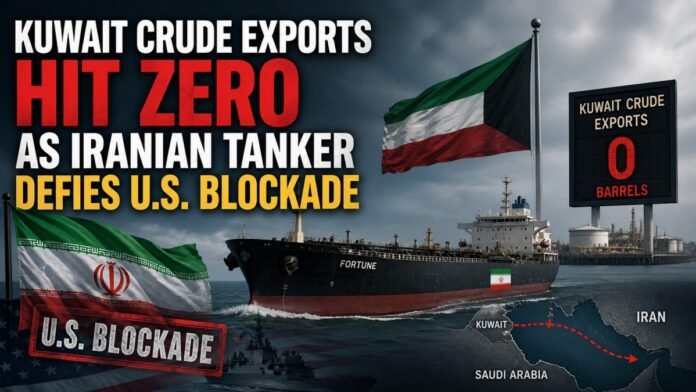
- Historic Standstill: Kuwaiti crude exports dropped to zero in April, the first such occurrence since the 1991 Gulf War.
- Refining Pivot: Kuwait continues full production but has diverted output to domestic storage and the Al Zour refinery to produce refined fuels.
- Blockade Breach: The Iranian VLCC supertanker “HUGE” bypassed the U.S. Navy with 1.9 million barrels of crude oil.
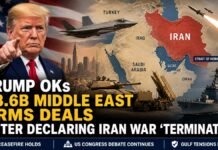
- Hormuz Shutdown: The ongoing closure of the Strait of Hormuz has removed approximately 13 million barrels per day from global supply chains.
- Tracking Evasion: The vessel Huge switched off its AIS tracking on March 20, recently resurfacing near the Lombok Strait in Indonesia.
The escalating instability in West Asia has delivered a staggering blow to global energy markets, as Kuwait recorded a complete halt in crude oil exports for the month of April 2026. This unprecedented disruption marks the first time in more than three decades, since the conclusion of the 1991 Gulf War, that the nation has failed to ship a single barrel of crude to international buyers.
According to data released by maritime monitor TankerTrackers, the total cessation of exports is a direct consequence of the closure of the Strait of Hormuz, which was shuttered following military strikes in late February. While Kuwait remains a top-tier OPEC producer, the logistical impossibility of navigating the blockaded waterway has effectively severed its primary trade artery. Experts suggest that if the conflict does not resolve, Kuwait may not see a return to normal export volumes for another three to four months.
Strategic Storage and Local Refining
Despite the export freeze, Kuwaiti oil fields have not gone silent. In a strategic maneuver to preserve its economic infrastructure, the government has maintained steady production levels, opting instead to funnel the extracted crude into massive domestic storage facilities.
A significant portion of this oil is being processed at the Al Zour refinery, the world’s largest grassroots refinery with a capacity of 615,000 barrels per day. By converting crude into refined petroleum products locally, Kuwait is attempting to export smaller, higher-value volumes of clean fuels while waiting for a diplomatic or military resolution to the maritime deadlock. This “refine and store” strategy is serving as a critical buffer for the Kuwaiti economy during the current regional turmoil.
The Escape of the “HUGE” Supertanker
In a major challenge to the U.S. Navy’s enforcement of “Operation Epic Fury,” an Iranian supertanker has successfully breached the naval blockade. The vessel, a Very Large Crude Carrier (VLCC) named Huge, is reportedly carrying 1.9 million barrels of crude oil with an estimated market value of $220 million.
The National Iranian Tanker Company (NITC) vessel managed to slip past monitoring efforts by disabling its Automatic Identification System (AIS) as early as March 20. After nearly six weeks in the “dark,” the tanker was identified by satellite imagery passing through the Lombok Strait in Indonesia. Its current trajectory toward the Riau Archipelago indicates that Tehran is successfully finding alternative routes to deliver energy to the Far East, despite the stringent maritime restrictions imposed on April 13.
A War of Attrition at Sea
The successful passage of the Huge has sparked a war of words between Washington and Tehran. While U.S. Central Command (CENTCOM) reports that its forces have intercepted or redirected 48 vessels in the past 20 days, Iranian state media claims that at least 52 vessels have successfully breached the blockade within a recent 72-hour window.
The International Energy Agency (IEA) warns that the combined impact of the Hormuz shutdown and the U.S. blockade has wiped 13 million barrels per day off the market, triggering one of the most severe energy crises in modern history. As the U.S. maintains that the blockade is costing Tehran billions in revenue, the arrival of the Huge in the Asia-Pacific suggests that the “Economic Fury” campaign remains vulnerable to high-stakes maritime evasion.