Key Points
- Continuous heavy downpours breached the boundary wall of the HPCL Patalganga LPG Bottling Plant in Chavne, flooding the facility completely.
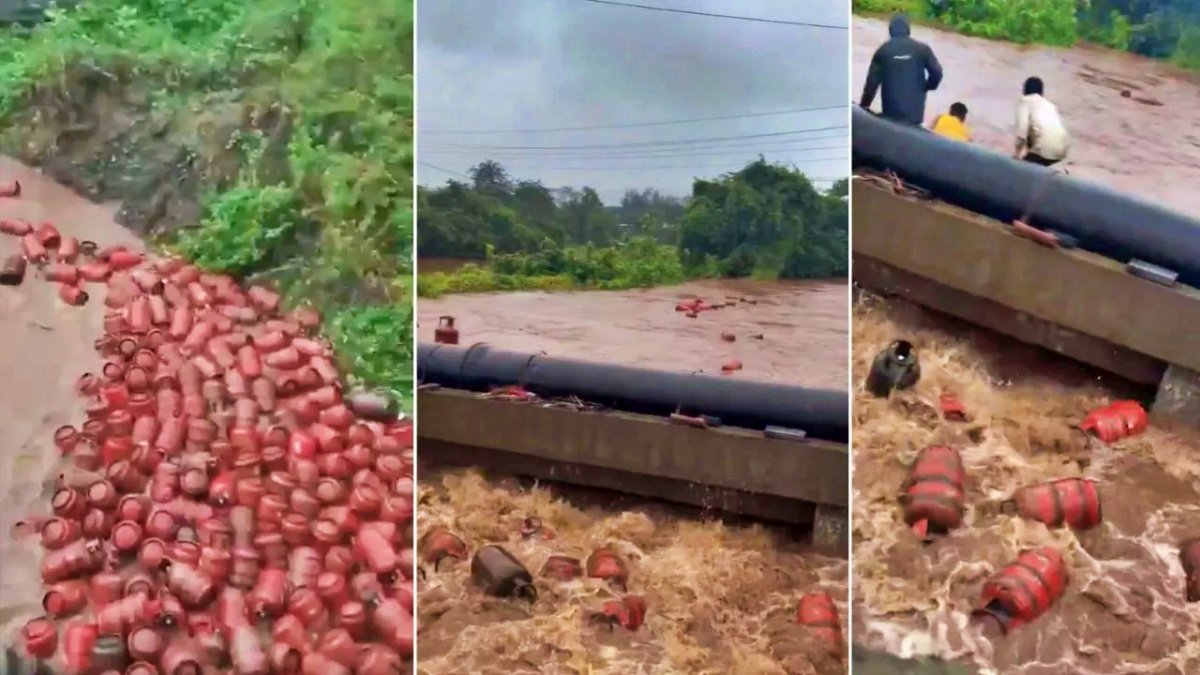
- Around 3,000 mixed full and empty gas cylinders were swept downstream into the Patalganga River and Kharpada Creek.
- Local villagers have been caught on video risking their lives to pull drifting cylinders ashore using makeshift hooks and ropes.
- Raigad District Collector Kishan Jawale has issued a high alert, warning residents that keeping or tampering with these cylinders poses a massive explosion risk.
- Dispatched disaster management teams and police units have successfully recovered roughly 1,000 cylinders so far, with search operations ongoing.
The relentless monsoon system battering coastal Maharashtra has escalated from a weather crisis into a severe industrial emergency in the Khalapur and Panvel talukas of Raigad. Incessant rainfall over a 24-hour period caused regional rivers to overflow, sending a sudden torrent of floodwater into the Maharashtra Industrial Development Corporation (MIDC) zone at Chavne.
The volume of water proved too intense for the Hindustan Petroleum Corporation Limited (HPCL) Patalganga LPG Bottling Plant, situated at Plot No. E-1/7. The facility’s protective boundary wall collapsed under the immense hydraulic pressure, allowing floodwaters to rapidly inundate the main storage yards. Within minutes, the powerful currents dislodged and swept roughly 3,000 commercial and domestic LPG cylinders directly into the adjacent Patalganga River.
Visual Chaos and Public Safety Hazards
Footage circulating widely on social media platforms captures the alarming sight of hundreds of bright red cylinders bobbing closely together in the muddy, fast-moving river currents, drifting rapidly toward Dharamtar Creek. The unusual scene quickly drew crowds to nearby bridges and banks.
However, the situation turned hazardous as local villagers began venturing into the swollen waters. Eyewitness accounts and videos show residents using iron hooks, ropes, and bare hands to drag the floating inventory ashore. Some individuals were seen carrying the cylinders back to their private residences, completely unaware of the structural and chemical volatility of the objects.
Official Safety Warning: “There is no guarantee whether the cylinders washed into the river contain gas or whether they are in a safe condition. Picking them up, opening them, or taking them home out of curiosity or for personal use could be extremely dangerous. Citizens should not put themselves at risk,” stated Raigad District Collector Kishan Jawale.
Safety professionals have echoed these concerns, explaining that underwater impacts can easily damage brass valves or compromise pressure seals. If a damaged, filled cylinder is stored in a confined domestic space, even a minor leak could trigger a catastrophic vapor cloud explosion.
Administrative Action and Recovery Operations
The Raigad district administration, alongside the Khalapur Police led by Police Inspector Abhijit Bhujbal, immediately deployed search and rescue infrastructure along the river’s path. Local revenue authorities and dedicated disaster management teams are actively monitoring the downstream channels to intercept the drifting inventory.
According to updated situational reports from Tahsildar offices, field teams have managed to safely retrieve and secure approximately 1,000 cylinders from the water and riverbanks.
The administration has issued a mandatory directive ordering all citizens to immediately surrender any collected cylinders. Recovered items must be deposited directly at:
- The primary HPCL Patalganga plant facility
- The nearest authorized local HPCL distribution agency
- The Tehsildar Office in Khalapur or Panvel
- The local Sub-Divisional Officer (SDO) headquarters
A comprehensive technical investigation is currently underway by HPCL safety engineers and state industrial inspectors to evaluate the plant’s structural vulnerabilities and audit the precise number of missing filled versus empty units.