


































Key Highlights
- Unused Arsenal: General Reza Talaei-Nik stated a “significant portion” of Iran’s advanced missiles remains in reserve.
- Air Dominance Claims: Iran asserts it maintained control over the skies of “occupied territories” until the April ceasefire began.
- Indigenous Production: The Ministry highlighted a domestic arsenal of over 1,000 weapon types across 9,000 cooperating firms.
- Russian Speculation: Moscow recently warned that the West remains “completely unaware” of Iran’s true, enigmatic military capabilities.
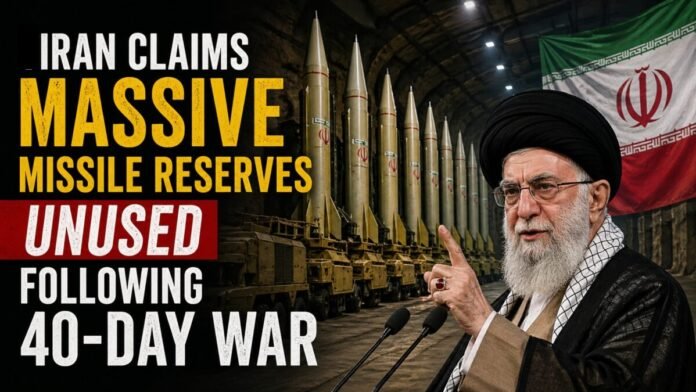
A significant global debate regarding Iran’s strategic missile capabilities has re-emerged following startling revelations from Tehran. Amidst the ongoing and intense friction between the Islamic Republic and the United States, the Iranian military has explicitly declared that it has not yet deployed its full force in the recent conflict with Israel and U.S. regional assets. This announcement has caused considerable concern within military circles in Washington and Tel Aviv, as officials weigh the possibility of a second, more destructive phase of hostilities.
The Iranian Ministry of Defense provided this clarification on Saturday, April 25, 2026, reflecting on the fierce conflict that spanned approximately 40 days before the current temporary ceasefire was established. According to the Ministry, the retaliatory strikes witnessed in March and early April represented only a fraction of the nation’s available firepower.
Claims of Sky Control and Strategic Reserves
General Reza Talaei-Nik, the spokesperson for the Ministry of Defense, issued a pivotal statement asserting that Iranian forces exercised “complete control” over the airspace above contested territories until the moment the ceasefire took effect. He emphasized that the military deliberately withheld a substantial stockpile of high-precision, advanced missiles, which are currently being held in a state of high readiness, should the truce fail.
“A significant portion of our missile capabilities remains unutilized,” Talaei-Nik stated, describing the restraint as a component of “strategic preparedness.” He credited this resilience to an indigenous production line that manufactures over 1,000 different types of weaponry, supported by a network of 9,000 domestic companies. This infrastructure, he argued, ensures that even if specific facilities are damaged, the support and production process continues across Iran’s geographical expanse.
The Russian Factor and Global Uncertainty
The tension has been further exacerbated by recent statements from Russia. Earlier this week, Kremlin officials voiced significant speculation regarding Iran’s “hidden and enigmatic” power, suggesting that the global community, particularly the United States, remains largely ignorant of Tehran’s true technological advancements in missile warfare. This Russian assessment, combined with Iran’s recent claims, suggests that the Middle Eastern conflict may not have reached a definitive conclusion despite the current cessation of strikes.
Trump Administration and the Post-Ceasefire Landscape
The 40-day conflict, which began in late February 2026, saw the United States and Israel target key nuclear facilities and military bases in an effort to neutralize Iran’s regional influence. While the Trump administration has repeatedly claimed that the Iranian military was “decimated” and its leadership fractured, the recent statements from Tehran tell a different story of a “social miracle” in defense mobilization.
As of late April, President Trump has extended shipping waivers to mitigate global oil price spikes but continues to enforce a strict naval blockade. With U.S. envoys currently in Pakistan for peace negotiations, the revelation of Iran’s unused arsenal serves as a stern warning that any resumption of hostilities could trigger a much larger, more sophisticated retaliatory response.