Key Highlights of the ADR Report
- Total Analyzed: 1,475 candidates across 152 constituencies.
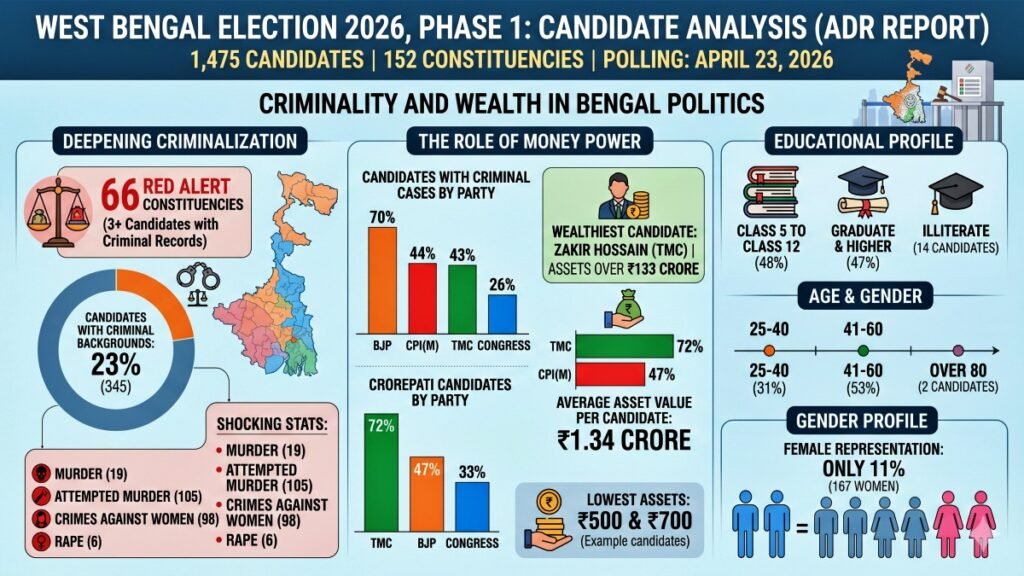
- Criminal Records: 345 candidates (23%) have criminal cases, 294 (20%) face serious charges.
- Red Alert Zones: 66 constituencies identified where three or more candidates have criminal backgrounds.
- Financial Elite: 309 candidates (21%) are crorepatis, with an average asset value of ₹1.34 crore.
- Gender Gap: Only 11% (167) of the candidates in the first phase are women.
As West Bengal prepares for the first phase of polling on April 23, 2026, the report from the Association for Democratic Reforms (ADR) and West Bengal Election Watch paints a sobering picture of the state’s political climate. The analysis, which scrutinized the affidavits of 1,475 candidates, highlights a persistent trend of criminalization.
The report identifies 66 “Red Alert” constituencies, areas where the choice for voters is severely compromised by the presence of multiple candidates with criminal records. The severity of these charges is particularly striking; 19 candidates are accused of murder, 105 face charges of attempted murder, and 98 are linked to crimes against women. Most concerningly, six candidates are facing grave allegations of rape.
Party-Wise Breakdown: BJP and TMC Statistics
The data reveal that no major political party is exempt from fielding candidates with tainted backgrounds, though the scale varies significantly:
| Political Party | Candidates with Criminal Cases | Serious Criminal Charges |
|---|---|---|
| BJP | 70% (106 of 152) | 63% |
| CPI(M) | 44% (43 of 98) | 37% |
| TMC | 43% (63 of 148) | 32% |
| Congress | 26% (39 of 151) | 22% |
Despite repeated Supreme Court mandates requiring parties to justify why they chose candidates with criminal antecedents over clean alternatives, the 2026 figures suggest these directives have had little impact on the selection process.
The Role of Money Power: Millionaire Candidates
Financial muscle continues to play a pivotal role in the electoral process. Roughly one-fifth of the candidates in this phase are crorepatis. The Trinamool Congress (TMC) leads in this category, with 72% of its candidates analyzed holding assets worth over ₹1 crore. The average asset value for a TMC candidate stands at a substantial ₹5.70 crore.
Zakir Hossain, the TMC candidate from Jangipur, remains the wealthiest individual in the fray with declared assets of ₹133.52 crore. Following him are Goutam Mishra (Shyam) from Barjora with ₹105.75 crore and Kabi Dutta from Durgapur Pashchim with ₹72.74 crore. In sharp contrast, the report notes the participation of candidates like Rubia Begum and Sushrita Saren, whose declared assets are as low as ₹500 and ₹700, respectively.
Demographics and Educational Profile
The candidate profiles show a diverse range of educational and age backgrounds, though representation remains uneven.
- Education: 48% of candidates have completed schooling up to the Class 12 level, while 47% are graduates or hold higher degrees. Notably, 14 candidates have declared themselves illiterate.
- Age: The majority of candidates (53%) belong to the 41 to 60 age bracket. Youth participation remains moderate, with 31% of candidates aged between 25 and 40. The field also includes two veteran candidates over the age of 80.
- Gender: Representation of women remains a significant concern, with only 167 women out of 1,475 candidates contesting in the first phase, signaling a continued struggle for gender parity in West Bengal’s legislative politics.