Key Highlights
- Operational Status: Effective as of January 12, 2026, following ratification by Russian President Vladimir Putin in late 2025.
- Troop Deployment: The pact permits up to 3,000 personnel, 5 warships, and 10 military aircraft to be stationed in the partner country.
- Arctic Access: India gains strategic entry to Russian naval bases in the Arctic and Far East, including Murmansk and Vladivostok.
- Strategic Autonomy: The agreement allows India to balance its defense ties between the U.S. and Russia, moving beyond the scope of existing U.S. logistics pacts.
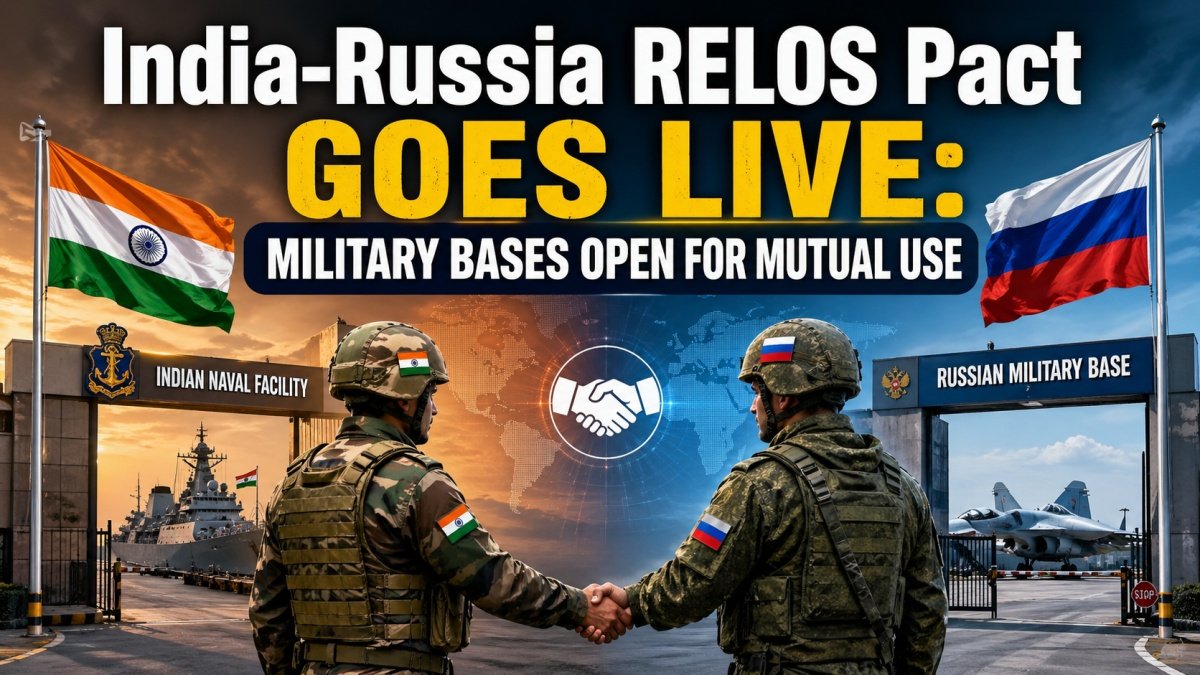
Following nearly a decade of complex negotiations, the Reciprocal Exchange of Logistics Support (RELOS) agreement has transitioned from a diplomatic proposal to an active military framework. Originally signed in Moscow in February 2025, the pact received its final legislative approval in December 2025, just ahead of the annual bilateral summit. As of early 2026, the two nations have officially opened their military infrastructure, including army bases, naval ports, and airfields, for mutual utilization in both peacetime and conflict scenarios.
The initial term for this agreement is five years, with a provision for extension. Beyond the physical presence of personnel, RELOS formalizes a comprehensive support network. It ensures that Indian and Russian assets can access essential services such as refueling, advanced technical repairs, and the provision of food and water, on a reimbursable or barter basis, significantly reducing the logistical burden of long-distance deployments.
Strategic Gains for the Kremlin and New Delhi
For Russia, the operationalization of RELOS is a geopolitical victory. Moscow has long sought a permanent logistical footprint in the Indian Ocean to support its fleet during extended missions. Amidst ongoing Western sanctions, the ability to maintain a sustained presence in this critical maritime zone enhances Russia’s power projection and secures its trade routes.
For India, the benefits are equally profound. The Indian Navy and Air Force now have formal access to Russia’s Far East and Arctic regions. This is particularly vital as the Arctic emerges as a major corridor for energy and global trade. By securing access to ports like Murmansk and Severomorsk, India strengthens its energy security and provides a necessary counterweight to expanding regional influences, all while ensuring a steady supply chain for its predominantly Russian-origin military hardware.
Navigating “Multi-Alignment” and U.S. Pressure
The timing of this activation is critical. While India has maintained the Logistics Exchange Memorandum of Agreement (LEMOA) with the United States since 2016, the RELOS pact is notably more comprehensive. Unlike LEMOA, which focuses primarily on refueling and supplies, RELOS explicitly allows for the physical deployment of military formations and combat assets.
By moving forward with this agreement, New Delhi has signaled to Washington and the global community that its foreign policy remains rooted in strategic autonomy. Despite significant pressure from the West to decouple from Moscow, the implementation of RELOS confirms that Russia remains India’s most trusted, long-term defense partner. This “multi-alignment” strategy allows India to leverage Western technology through U.S. partnerships while maintaining the deep-seated military integration that has defined its relationship with Russia for decades.