

































Key points
- India has dropped to sixth spot in global GDP rankings, ending a three-year streak as the fifth-largest economy.
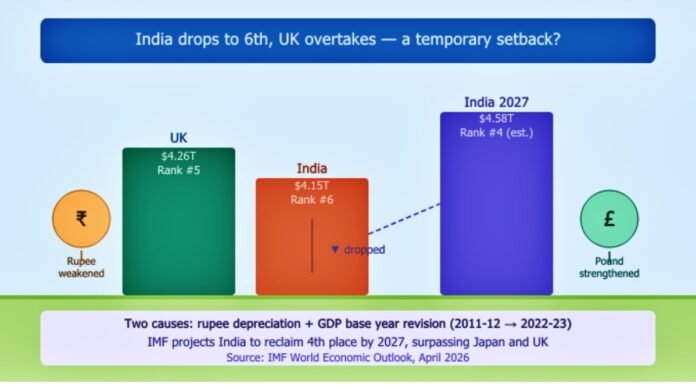
- India’s GDP is estimated at $3.92 trillion for 2025 (FY26) and $4.15 trillion for 2026 (FY27), while the UK is projected at $4 trillion and $4.26 trillion for the same years.
- Two primary causes: a weakening rupee and a revised GDP base year methodology.
- The IMF’s latest forecast expects India to bounce back and grab fourth place by 2027, overtaking both the UK and Japan.
India had, not long ago, celebrated projections of becoming the world’s fourth-largest economy. Those forecasts have since been revised downward by the IMF’s latest April 2026 update.
Why did India fall?
Two forces worked against India simultaneously.
The first is currency depreciation. A depreciation of nearly 10 percent in FY26 directly compressed India’s GDP when measured in dollar terms, the unit used to calculate global rankings. The British pound, by contrast, largely held its ground against the dollar, giving the UK a quiet but significant advantage in the comparison.
The second is a statistical overhaul. Fresh GDP estimates, released using a revised methodology and an updated base year of 2022-23, trimmed the country’s nominal output by more than ₹11 trillion. The revised figure places India’s nominal GDP for FY26 at ₹345.47 trillion ($3.93 trillion), compared with ₹357.14 trillion under the old methodology, a reduction of 3.26%.
The base year of national accounts has been revised from 2011-12 to 2022-23. FY 2022-23 was selected because it represents a recent normal year after the COVID-19 pandemic, with robust, comprehensive data across sectors of the economy, making it an appropriate benchmark. The new methodology introduces double deflation, particularly in manufacturing and agriculture, where both input prices and output prices are adjusted for inflation.
The IMF revised projections sharply. India’s 2027 estimate has been cut to $4.58 trillion from $4.96 trillion, a reduction of nearly $380 billion, compared to the October 2025 update.
Where do the world’s top economies stand?
| Rank | Country | GDP (Trillion USD, 2026 est.) |
|---|---|---|
| 1 | USA | $32.38 |
| 2 | China | $20.85 |
| 3 | Germany | $5.45 |
| 4 | Japan | $4.38 |
| 5 | UK | $4.26 |
| 6 | India | $4.15 |
The setback is likely temporary. India is expected to reclaim lost ground and reach fourth place by 2027 (FY28), overtaking both the UK and Japan. The margins, at that point, are quite small, with an estimated $113 billion over the UK and just $17 billion over Japan.
Currency strength matters as much as growth. The Central Government and the RBI are actively working to manage rupee volatility. Experts argue that India must reduce its dependence on imports and strengthen exports. Whilst nominal GDP has shrunk, real GDP growth under the new series is actually marginally healthier, clocking 7.6% for FY26, some 20 basis points above the earlier estimate. This underscores a key lesson: a high domestic growth rate alone is not enough. In a world where economies are benchmarked in dollar terms, the global value of a nation’s currency is an equally decisive factor in the race for economic supremacy.