Key Highlights
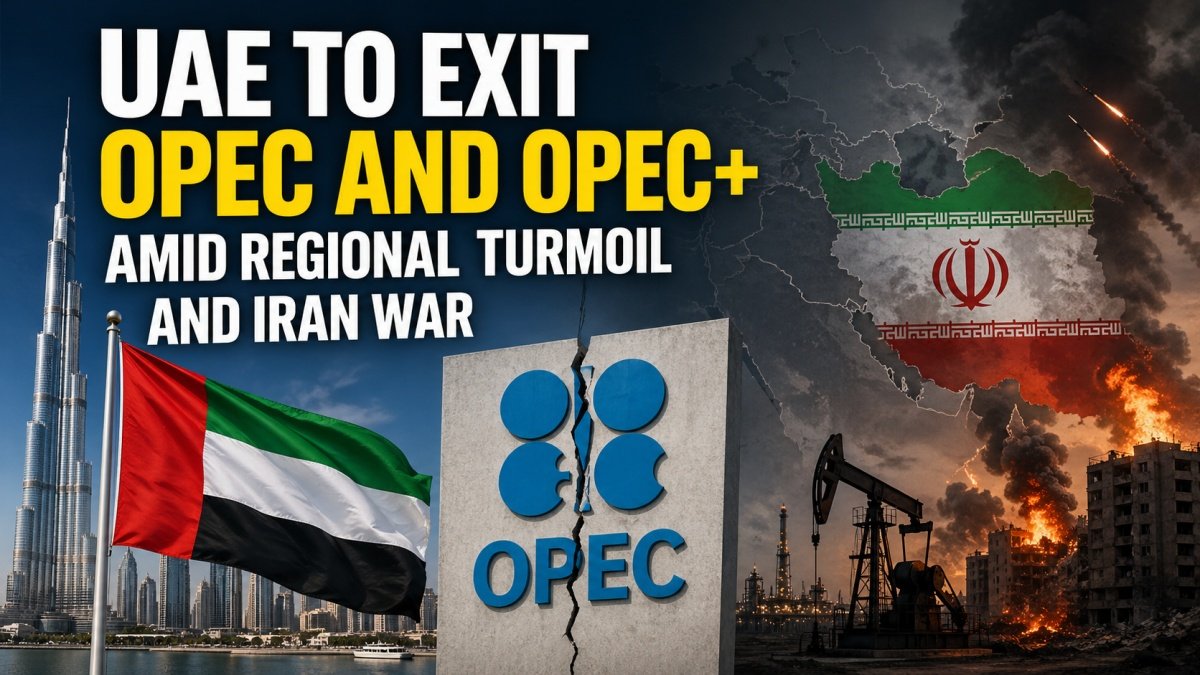
- Official Exit: The UAE will formally leave the oil cartel on May 1, 2026, ending nearly 60 years of membership.
- Production Freedom: The move allows Abu Dhabi to bypass OPEC quotas as it targets a production capacity of 5 million barrels per day.
- Regional Friction: Strained relations with Saudi Arabia and a “crisis of confidence” within the GCC are cited as primary drivers.
- Impact of Iran War: Persistent disruptions in the Strait of Hormuz have slashed UAE oil exports, necessitating a more agile national policy.
- Global Shift: Analysts view the exit as a blow to Saudi influence and a potential victory for U.S. efforts to lower energy costs.
In a development that has sent shockwaves through international markets, the United Arab Emirates (UAE) confirmed on Tuesday that it is withdrawing from the Organization of the Petroleum Exporting Countries (OPEC) and the broader OPEC+ alliance. The state-run WAM news agency reported that the withdrawal will take effect on May 1, 2026, marking the end of a membership that began in 1967.
The UAE Energy Minister, Suhail Al Mazrouei, stated that the decision followed a “meticulous review” of the nation’s strategic imperatives. As global demand for energy continues to rise despite the current instability, the UAE intends to prioritize its national economic interests and investment commitments over collective production constraints.
The Conflict Context: Iran War and Hormuz Blockade
The timing of this departure is inextricably linked to the “Iran war,” which began on February 28, 2026, and the subsequent blockade of the Strait of Hormuz. This narrow passage, a crucial maritime route for 20 percent of the world’s oil, has become a flashpoint for military and economic confrontation.
Recent data reveals that UAE oil production plunged by 44 percent in March alone, largely because the naval blockade prevented tankers from reaching international markets. By exiting OPEC, the UAE gains the flexibility to ramp up production and explore alternative export strategies once regional stability is restored, moving toward its long-held goal of 5 million barrels per day, a target previously hampered by OPEC+ quotas.
Eroding Alliances and the GCC Crisis
Beyond economics, the decision highlights deep-seated geopolitical rifts. Anwar Gargash, the diplomatic advisor to the UAE President, recently issued a scathing critique of the Gulf Cooperation Council (GCC), stating that the alliance’s cohesion is at its “lowest ebb in history.”
Gargash suggested that the UAE felt isolated during recent Iranian aggression, claiming that fellow Gulf nations failed to provide adequate political and military support. This perceived lack of a unified security front has compelled Abu Dhabi to seek more autonomous foreign and energy policies, diverging from the traditional leadership of Saudi Arabia.
Strategic Implications for Washington and Riyadh
The UAE’s exit is being framed as a significant blow to Saudi Arabia’s de facto leadership of the oil cartel. For decades, Riyadh and Abu Dhabi have been the twin pillars of OPEC, but friction over production baselines and regional competition has finally reached a breaking point.
Conversely, the move is seen as a major diplomatic victory for U.S. President Donald Trump. Trump has consistently pressured Gulf allies to decouple their energy policies from cartel-driven price hikes, arguing that U.S. security support should be met with lower oil prices. The departure of a top-tier ally like the UAE from OPEC validates Trump’s “America First” energy agenda and could trigger a competitive “price war” that further weakens the cartel’s global influence.
As the world watches the May 1 transition, the focus remains on the Strait of Hormuz, where the UN continues to call for an open, toll-free passage to prevent a total collapse of global energy security.