
































Key Highlights
- Massive Turnout Expected: Iranian authorities anticipate between 15 million and 20 million attendees congregating across several cities for the six-day state ceremonies.
- Classified Casualty Warnings: A leaked memo from the Iranian Red Crescent and the National Crisis Management organization warns of 1,500 to 3,000 potential deaths due to overcrowding and severe summer heat.
- Emergency Infrastructure Built: Over a thousand new graves have been systematically dug at Tehran’s Behesht-e Zahra cemetery to ensure city management does not lose control of a mass contingency.
- A History of Crowd Disasters: The preemptive measures are heavily influenced by lethal stampedes during the historical funerals of Ayatollah Ruhollah Khomeini in 1989 and General Qasem Soleimani in 2020.
As the marathon six-day state funeral ceremonies for the late Supreme Leader Ayatollah Ali Khamenei commence across Iran, a stark operational assessment has emerged from within the clerical establishment. According to an investigative report published by the German media outlet WELT, the Iranian government is quietly making grim preparations to handle a mass casualty event. High-level intelligence indicators reveal that municipal teams have dug thousands of emergency graves in anticipation of catastrophic crowd crushes and severe climate exposure.
The scale of the multi-city funeral procession, which spans from July 4 to July 9, 2026, has prompted unprecedented logistical mobilization. With state planners projecting a turnout of 15 million to 20 million mourners, the internal security apparatus remains deeply anxious about crowd density and public safety.
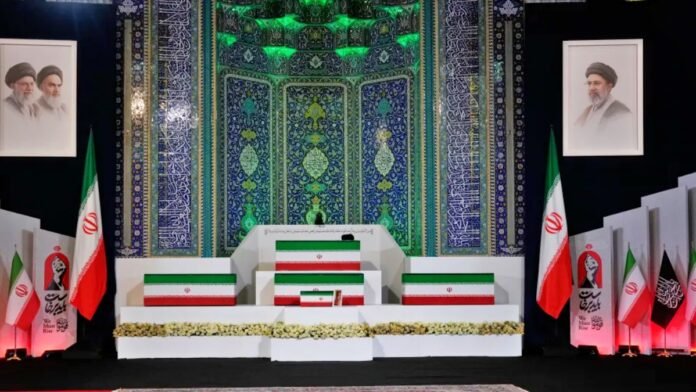
In the image above, the central platform of the Imam Khomeini Grand Mosalla in Tehran illustrates the meticulous and heavily secured environment the state has constructed. The perimeter of the caskets is reinforced with thick concrete blocks to control the physical flow of the massive crowds, directly reflecting the state’s deep structural concerns regarding crowd control and administrative containment.
Leaked Red Crescent Correspondence Details Grim Projections
The preemptive measures came to light after investigative journalists uncovered a highly classified letter transmitted by the National Crisis Management organization and the Iranian Red Crescent. The correspondence, addressed directly to Iran’s First Vice President, Mohammad Reza Aref, explicitly warns that the compounding factors of intense summer heat waves and packed urban corridors create an extreme risk environment.
The secret internal assessment projects a potential death toll ranging between 1,500 and 3,000 individuals over the course of the week. To maintain civil order, the government chose to deploy a specialized crisis response cell alongside municipal engineering units to expand burial capacities rapidly. A municipal official in Tehran confirmed the operation under a pseudonym, stating that the contingency infrastructure is fully active so that if thousands of attendees succumb to heatstroke or sudden surges, the municipal system can prevent the situation from spiraling completely out of control.
A Dark History of Funeral Stampedes Shapes Present Strategy
The current administration’s profound apprehension is anchored in a historical pattern of tragic crowd dynamics during state-sponsored burials. This security blueprint is directly designed to avoid the catastrophic failures of the past, specifically looking back at two major historical milestones:
- The 1989 Funeral of Ayatollah Ruhollah Khomeini: During the burial of the Islamic Republic’s founder, millions of distraught mourners overwhelmed the security cordons. The chaotic crush resulted in eight confirmed deaths, hundreds of critical injuries, and an interrupted procession where the body had to be temporarily evacuated by a military helicopter.
- The 2020 Funeral of General Qasem Soleimani: Following the assassination of the Quds Force commander, a massive bottleneck in his hometown of Kerman triggered a severe stampede. The disaster claimed the lives of 56 individuals and left over 200 injured, forcing authorities to delay the final interment.
With the current state ceremonies representing the most significant political transition in decades, the execution of these tight crowd-control measures highlights the complex tightrope the government is walking, balancing a massive geopolitical show of strength with the volatile realities of immense public assemblies.