Key Points
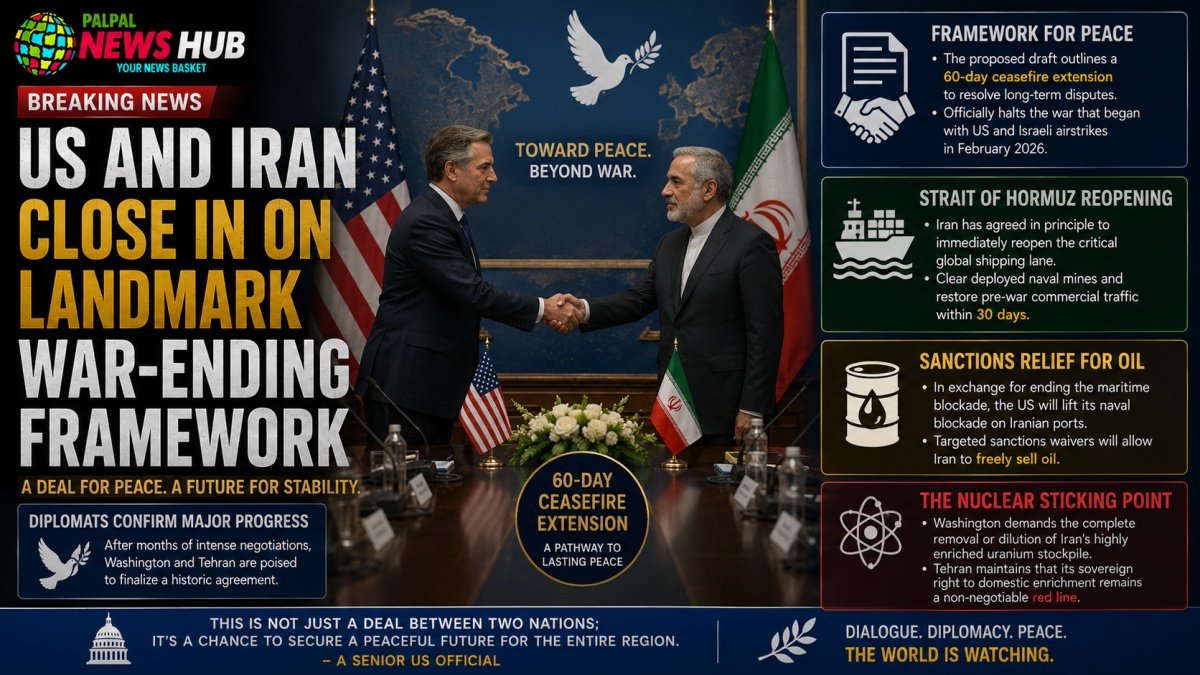
- Framework for Peace: The proposed draft outlines a 60-day ceasefire extension to resolve long-term disputes, officially halting a war that began with US and Israeli airstrikes in February 2026.
- Strait of Hormuz Reopening: Iran has agreed in principle to immediately reopen the critical global shipping lane, clear deployed naval mines, and restore pre-war commercial traffic within 30 days.
- Sanctions Relief for Oil: In exchange for ending the maritime blockade, the US will lift its naval blockade on Iranian ports and issue targeted sanctions waivers allowing Iran to freely sell oil.
- The Nuclear Sticking Point: While Washington demands the complete removal or dilution of Iran’s highly enriched uranium stockpile, Tehran maintains that its sovereign right to domestic enrichment remains a non-negotiable red line.
Following a major announcement by US President Donald Trump over the weekend declaring that a peace accord has been “largely negotiated,” senior American and Iranian officials have confirmed they are closing in on a historic framework to terminate their intense, 12-week war. Spearheaded by back-channel mediation from Pakistan, Qatar, and Oman, the impending Memorandum of Understanding aims to formalize a renewable 60-day ceasefire extension and structurally de-escalate the volatile Middle Eastern theater.
Despite intense diplomatic momentum, including high-level Iranian delegations traveling to Doha and Islamabad, the text has not yet received its final seal of approval. US officials emphasize that while a conceptual breakthrough has been achieved, rigorous diplomatic wrangling over specific legal terminology, enforcement timelines, and underlying security guarantees could delay a formal signing ceremony for several more days.
President Trump highlighted the delicate balance on social media, writing that negotiations are “proceeding nicely” but warning that it will either be a “Great Deal for all, or no Deal at all,” which would trigger an immediate return to active hostilities.
De-Escalation Terms and the Strait of Hormuz
The primary breakthrough of the draft proposal centers on restoring stability to global energy markets by unblocking the Strait of Hormuz, an international transit route through which roughly 20% of the world’s petroleum passes. Since the onset of the war, the waterway has been paralyzed by intense fighting, Iranian anti-ship mining operations, and a retaliatory US naval counter-blockade on Iranian ports.
Under the negotiated 30-day operational phase, the maritime security framework dictates:
- Mine Clearance: Iran will deactivate and remove its naval minefields to guarantee safe passage for international commercial shipping.
- Toll-Free Transit: Commercial vessels will navigate the strait entirely free of transit tariffs. US negotiators have explicitly blocked an Iranian attempt to reframe transit tolls as “protection or environmental fees.”
- Blockade Reciprocity: Simultaneously, the United States will roll back its naval containment of Iran’s coastline, allowing merchant ships to safely access Iranian commercial harbors.
The Nuclear Standoff and Financial Asset Wrangling
While the broader stabilization framework is largely settled, the precise wording on “several key points” regarding Iran’s nuclear infrastructure remains the most volatile obstacle in the room. The Trump administration and its regional allies, notably Israel, are demanding an ironclad, upfront commitment from Tehran to completely relinquish, dilute, or export its 440.9-kilogram stockpile of 60% highly enriched uranium (HEU), a technical step away from weapons-grade purity.
Iranian Foreign Ministry spokesman Esmaeil Baqaei pushed back against these claims, stating that current talks are strictly confined to ending active warfare and establishing navigational freedom, rather than detailing long-term nuclear concessions. Revolutionary Guard-affiliated media networks have reasserted that any US demand for “zero domestic enrichment” remains an absolute red line. Iran has reportedly expressed a tentative willingness to transfer its HEU material to a neutral third party, such as the People’s Republic of China, but is demanding rigid geopolitical guarantees before executing the transfer.
Finances also remain a critical leverage point. Tehran has informed Pakistani mediators that it will not sign the preliminary accord unless the United States provides immediate, upfront access to a portion of its $25 billion in frozen overseas assets, currently blocked in international banks like the Qatar National Bank. The US position maintains that any gradual sanctions relief or asset unfreezing will remain strictly conditional, unfolding in phases tied directly to Iran’s verifiable compliance on the ground.