



































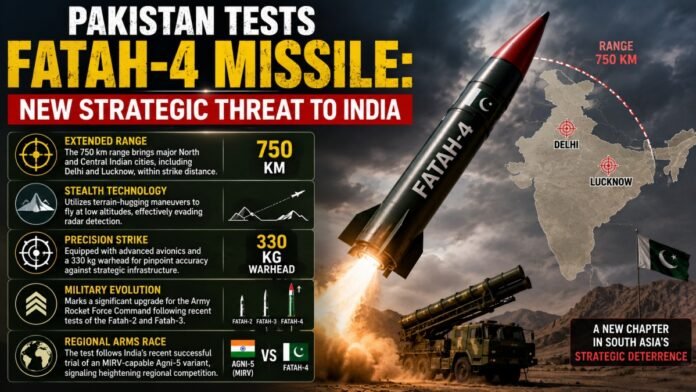
Key Points
- Extended Range: The 750 km range brings major North and Central Indian cities, including Delhi and Lucknow, within strike distance.
- Stealth Technology: Utilizes terrain-hugging maneuvers to fly at low altitudes, effectively evading radar detection.
- Precision Strike: Equipped with advanced avionics and a 330 kg warhead for pinpoint accuracy against strategic infrastructure.
- Military Evolution: Marks a significant upgrade for the Army Rocket Force Command following recent tests of the Fatah-2 and Fatah-3.
- Regional Arms Race: The test follows India’s recent successful trial of an MIRV-capable Agni-5 variant, signaling heightening regional competition.
The landscape of South Asian regional security shifted today as Pakistan announced the successful flight test of the ‘Fatah-4’ ground-launched cruise missile. Conducted on Thursday, May 14, 2026, the test was supervised by the Army Rocket Force Command, marking a major milestone in Pakistan’s quest for conventional counterforce capabilities.
The Fatah-4 represents a substantial leap over its predecessors. While the Fatah-1 and Fatah-2 focused on shorter tactical ranges, the Fatah-4 boasts a strike range of 750 kilometers. This expansion is not merely about distance; it is about the sophisticated “terrain-hugging” technology that allows the missile to skim the ground at low altitudes. By doing so, it exploits gaps in traditional radar coverage, making it a formidable challenge for even modern interception systems.
Technical Superiority and the Chinese Influence
According to official military statements, the Fatah-4 is equipped with “high precision” navigational aids and state-of-the-art avionics. Capable of carrying a 330-kilogram warhead, the system is designed to neutralize high-value targets, such as command centers and military airbases, with absolute accuracy.
While Islamabad maintains that the Fatah series is a domestic achievement, defense analysts point toward deepening technical cooperation with China. The Fatah-4 likely benefits from technologies shared during the development of China’s own cruise missile programs, providing Pakistan with a viable conventional alternative to its nuclear-capable assets. This development follows only weeks after the unveiling of the Fatah-3, a supersonic variant designed to close the gap with India’s BrahMos missile system.
India’s Defensive Posture and Countermeasures
The timing of the test is notable, occurring just days after India’s Ministry of Defence confirmed the successful trial of an advanced Agni-5 variant on May 10, 2026. India’s “Mission Divyastra” showcased Multiple Independently Targetable Re-entry Vehicle (MIRV) technology, allowing a single missile to deliver several warheads across different locations.
In response to Pakistan’s cruise missile advancements, India continues to fortify its multi-layered air defense shield. The deployment of the Russian-made S-400 Triumph, alongside the indigenous Akash and Barak-8 systems, forms the backbone of India’s interceptor strategy. Furthermore, India’s Agni-5 boasts a range exceeding 5,000 kilometers and features a unique mid-flight maneuvering capability, including a 90-degree turn, specifically designed to bypass enemy anti-ballistic missile (ABM) defenses.
Geopolitical Implications: Cities in the Strike Envelope
The 750-kilometer reach of the Fatah-4 has raised immediate concerns for Indian security planners. If deployed near border regions like Sialkot or Lahore, the missile places several critical Indian hubs within its operational envelope:
- Delhi-NCR: The national capital region, including Delhi, Gurugram, and Noida, sits approximately 450 to 550 km from the border, well within the Fatah-4’s reach.
- Strategic Northern Bases: Sensitive military installations in Jammu, Pathankot, and Udhampur, as well as the plains of Punjab and Haryana, are now under increased surveillance.
- Central India and Rajasthan: Significant portions of Rajasthan, including Jodhpur and Bikaner, along with Uttar Pradesh’s capital, Lucknow, now fall within the potential strike zone.
As both nations continue to iterate on their missile technology, the Fatah-4 test underscores a period of intense technological competition, forcing a recalibration of defensive strategies across the subcontinent.