Key Points
- Saudi Arabia and Kuwait have restored U.S. access to key military infrastructure, including the Prince Sultan Airbase.
- “Operation Freedom,” also known as “Project Freedom,” will resume after a 36-hour suspension earlier this week.
- The mission involves a “Red, White, and Blue Dome” of over 100 aircraft and guided-missile destroyers to protect commercial shipping.
- The diplomatic breakthrough follows high-level negotiations between President Donald Trump and Saudi Crown Prince Mohammed bin Salman.
- The reopening of the Strait is vital for global energy markets, as approximately 20% of the world’s oil trade passes through this chokepoint.
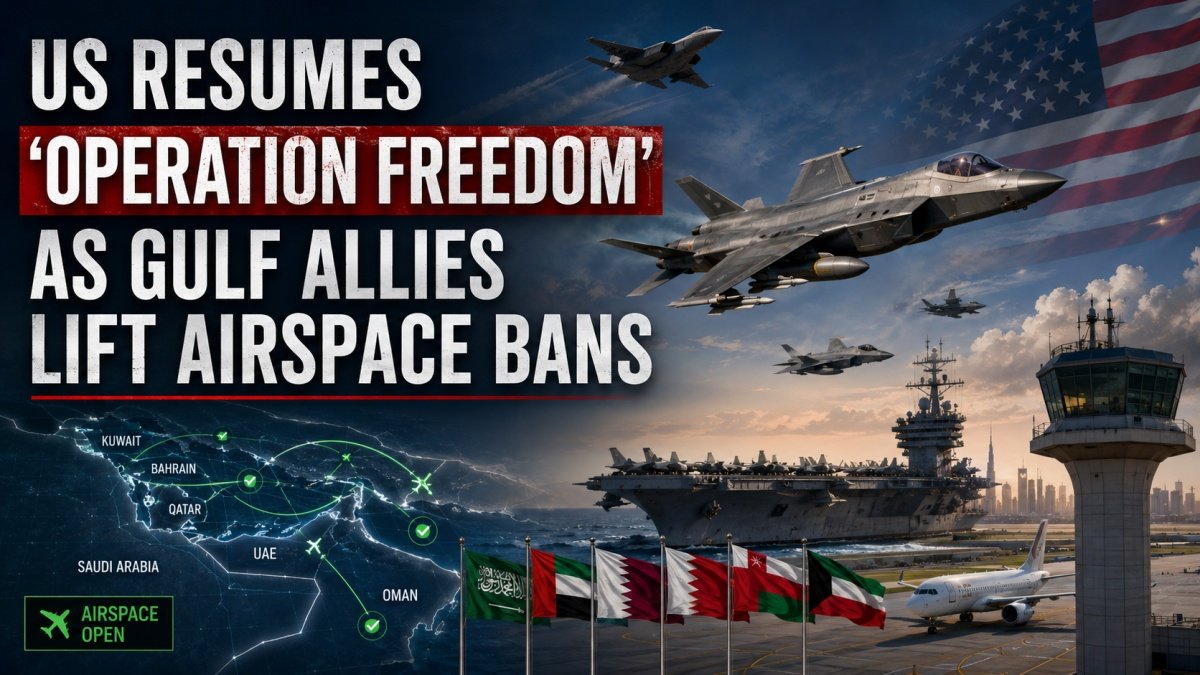
Under “Operation Freedom,” the United States and its military have achieved a major and historic success. In a significant shift for regional security, Saudi Arabia and Kuwait have granted permission for U.S. jets to utilize their airspace and have completely lifted long-standing restrictions previously imposed on critical U.S. military bases.
This move is expected to significantly bolster the security of numerous commercial vessels currently navigating the Strait of Hormuz, providing a level of protection far greater than ever before. For the Trump administration, the reversal of these restrictions marks a pivotal win, clearing the path for the U.S. to project power directly over one of the world’s most volatile maritime corridors.
The Resurrection of Operation Freedom
The United States is now preparing to relaunch “Operation Freedom,” a critical mission dedicated to providing naval security to its vessels in the region. The mission had a turbulent start, having been abruptly halted within just 36 hours of its commencement earlier this week.
According to senior Pentagon officials, the operation could be resumed as early as this week. The initial pause was triggered after a series of Iranian retaliatory strikes on the UAE oil hub of Fujairah, which caused regional allies to fear they were becoming targets. However, following a series of telephone conversations between President Donald Trump and Saudi Crown Prince Mohammed bin Salman, the two nations have reconciled their strategic differences.
The “Red, White, and Blue Dome”
Defense Secretary Pete Hegseth recently characterized the massive scale of the operation as a “powerful red, white, and blue dome” over the Strait. The tactical framework for Operation Freedom includes:
- Guided-Missile Destroyers: On-station support to intercept anti-ship cruise missiles.
- Aerial Overwatch: More than 100 land and sea-based aircraft, including fighter jets, helicopters, and drones.
- Personnel Deployment: Approximately 15,000 service members are dedicated to the maritime corridor.
- Intelligence Support: Direct guidance for commercial vessels to navigate through mine-cleared lanes.
Global Trade and the Hormuz Lifeline
The importance of the Strait of Hormuz for global trade cannot be overstated. As a critical lifeline for the world’s global oil supply, any disruption in the Strait ripples through international markets almost instantly. To ensure the waterway remains fully open, the United States requires a massive and powerful air fleet to shield merchant ships from the lethal threats posed by Iranian missiles and drones.
Access to the airspace of Saudi Arabia and Kuwait is considered absolutely critical for this mission to achieve resounding success. The primary objective is to restore complete naval security for global shipping and lower the “war risk” insurance premiums that have skyrocketed in recent weeks. As of May 8, 2026, while diplomatic efforts via Pakistan continue, the regional military footprint is expanding to its highest level in years, signaling that the U.S. is prepared to maintain the flow of energy at any cost.