

































Key Developments in the Middle East Drone Crisis
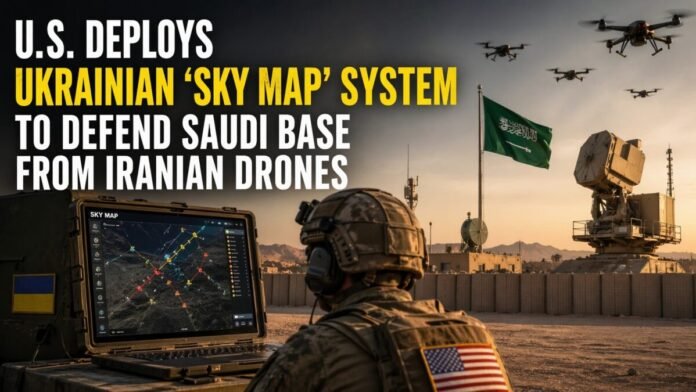
- Technology Transfer: Ukrainian military specialists have arrived at Prince Sultan Air Base (PSAB) to train U.S. troops on the ‘Sky Map’ system.
- Operational Pivot: The deployment follows a devastating March 27 attack that damaged a USAF E-3 Sentry AWACS and multiple KC-135 tankers.
- Political Reversal: This move contradicts President Donald Trump’s March 6 public dismissal of Ukrainian assistance in drone defense.
- Tactical Solution: ‘Sky Map’ utilizes a network of acoustic sensors and integrated radar to neutralize Iranian-made Shahed drones.
- Strategic Initiative: The Pentagon has allocated $350 million under ‘Operation Epic Fury’ to transition toward affordable, mass-produced drone defenses.
The escalating conflict in the Middle East has exposed what defense analysts call the “Interceptor Trap,” a mathematical crisis where the U.S. and its partners have been forced to fire $4 million PAC-3 missiles to down $30,000 Iranian Shahed drones. This economic imbalance has led to the depletion of air defense stocks, leaving high-value assets vulnerable.
The vulnerability was laid bare on March 27, 2026, when a barrage of Iranian missiles and drones struck Prince Sultan Air Base. The attack destroyed a sophisticated E-3 Sentry AWACS radar aircraft and inflicted damage on several KC-135 refueling tankers and THAAD missile system components. With approximately 10 service members wounded in that single engagement, the Pentagon determined that traditional missile defense architecture was insufficient against “affordable mass.”
How ‘Sky Map’ Changes the Battlefield
Developed by the Ukrainian firm Sky Fortress and funded by the Brave 1 unit, ‘Sky Map’ was forged in the fires of the Russia-Ukraine war. Unlike traditional radar-heavy systems, it relies on a vast network of over 10,000 acoustic sensors that detect the unique engine signatures of incoming drones.
The platform provides U.S. operators with a comprehensive dashboard, combining radar data, sensor feeds, and video into a single interface. This allows for the precise targeting of threats by interceptor drones, such as the LUCAS (Low-cost Uncrewed Combat Attack System), which are essentially reverse-engineered clones of the Shahed-136. By using these $35,000 interceptors, the U.S. can finally match the enemy’s cost-to-kill ratio.
Navigating Political Friction
The deployment is being viewed as a pragmatic but quiet reversal of official White House rhetoric. Just weeks ago, on March 6, President Donald Trump told reporters that the U.S. did not require Ukrainian aid, stating, “We don’t need their help.” However, the severity of the damage sustained at PSAB, located just 640 kilometers from Iran, reportedly forced a shift in policy.
Under the direction of Secretary of War Pete Hegseth, the U.S. has now prioritized ‘Operation Epic Fury,’ a mission focused on dismantling Iranian missile production and security infrastructure while adopting Ukrainian innovations to protect regional hubs.
A New Era of Air Defense
Timothy Walton, a senior fellow at the Hudson Institute, notes that this deployment marks a historic shift in modern warfare. For the first time, the U.S. military is relying on foreign, battlefield-refined software to close gaps in its own air defense network.
The integration of ‘Sky Map’ at PSAB is expected to serve as a blueprint for other U.S. installations across the Middle East. As Ukrainian specialists continue to train American crews, the goal is to create a seamless, low-cost defensive shield that can withstand the sustained drone barrages that have characterized the 2026 conflict.