




































Key Points
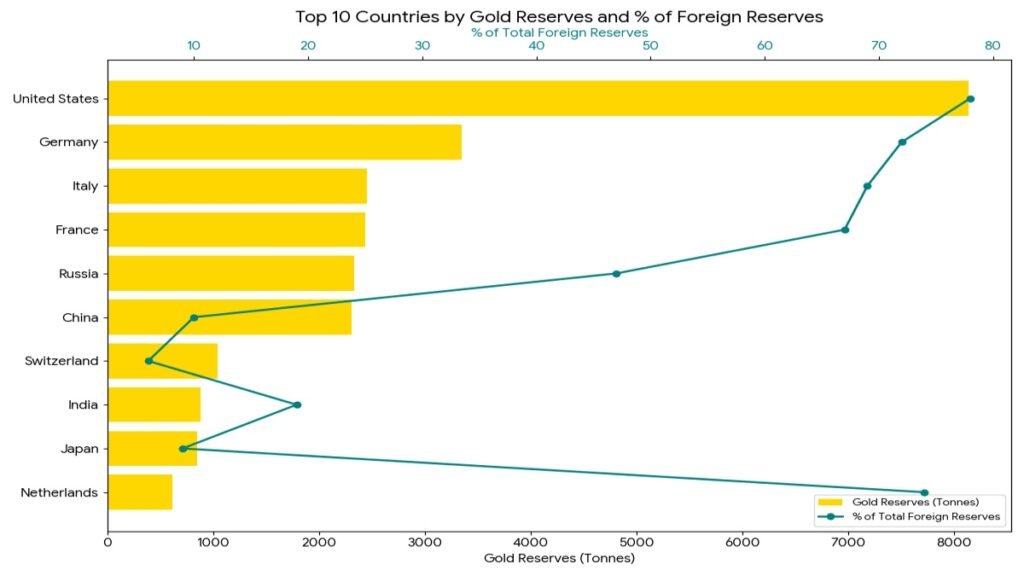
- US Dominance: The United States remains the global leader with 8,133.5 tonnes, representing a massive 78% of its total foreign reserves.
- China’s Momentum: The People’s Bank of China (PBoC) has extended its buying streak to 15 consecutive months, reaching a recorded 2,308 tonnes.
- India’s Sovereignty: The Reserve Bank of India has repatriated 274 tonnes of gold from UK vaults since 2023, bringing 65% of its total reserves onto domestic soil.
- Price Volatility: After a historic peak of $5,634 per ounce in January 2026, prices have stabilized near $4,500 amid ongoing safe-haven demand.
- The 10th Spot Battle: Turkey and the Netherlands continue to swap rankings, with Turkey’s tactical buying frequently challenging the Dutch position in early 2026.
The global economic landscape of early 2026 is defined by a flight to “real” assets. As the Iran-Israel conflict approaches its one-month mark and global trade routes face continued uncertainty, gold has transitioned from a passive reserve asset to an active tool of national sovereignty. Central banks have become the primary drivers of market demand, prioritizing the diversification of assets away from the US dollar to mitigate the risks of international sanctions and currency debasement.
According to the latest March 2026 data from the World Gold Council and the IMF, the hierarchy of gold ownership remains remarkably stable at the top, yet dynamic in the middle tier.
Top 10 Countries by Gold Reserves (March 2026)
| Rank | Country | Gold Reserves (Tonnes) | % of Total Foreign Reserves |
|---|---|---|---|
| 1 | United States | 8,133.5 | ~78% |
| 2 | Germany | 3,350.3 | ~72% |
| 3 | Italy | 2,451.8 | ~69% |
| 4 | France | 2,437.0 | ~67% |
| 5 | Russia | 2,332.5 | ~47% |
| 6 | China | 2,308.2 | ~10% |
| 7 | Switzerland | 1,039.9 | ~6% |
| 8 | India | 880.3 | ~19% |
| 9 | Japan | 846.0 | ~9% |
| 10 | Netherlands | 612.5 | ~74% |
Strategic Analysis of 2026 Trends
The Rise of “Homebound” Gold
One of the most significant shifts in 2026 is the physical relocation of reserves. India has been at the forefront of this movement, executing one of the largest gold repatriations in history. By moving over 274 tonnes from the Bank of England back to vaults in Mumbai and Nagpur, the Reserve Bank of India (RBI) has reduced its reliance on foreign custodians. This “sovereignty strategy” ensures that India’s 880.3 tonnes are directly accessible during global crises. Furthermore, while official reserves are growing, Indian households remain the world’s largest private “vault,” holding an estimated 25,000 tonnes in private jewelry.
China and Russia’s De-Dollarization
The “Accumulators,” China and Russia, continue to view gold as a strategic weapon against Western financial hegemony. China’s official holdings reached 2,308 tonnes this month, though analysts suggest total holdings, including those in non-reported accounts, could be substantially higher. For these nations, gold provides a “sanction, proof” layer of liquidity that supports their push for a more multipolar financial system.
Record-Breaking Market Values
The start of 2026 saw gold prices hit an eye, watering $5,634 per ounce in January, driven by a surge in Exchange Traded Fund (ETF) inflows and panic buying following the outbreak of hostilities in the Middle East. While the market has seen a healthy correction to the $4,500 to $4,600 range in March, the valuation of national reserves has still tripled compared to decade ago averages. This has dramatically improved the balance sheets of gold, heavy nations like Italy, Germany, and the Netherlands, where gold now accounts for over 70% of total foreign reserves.
The Stability of the “Safe Haven”
The 10th position remains a point of contention. While the Netherlands currently holds a slight lead with 612.5 tonnes, Turkey has been a volatile competitor, briefly moving into the top 10 earlier this year before selling small amounts to manage domestic currency fluctuations. Regardless of the rank, the message from central banks is clear: in an era of electronic wealth and geopolitical friction, physical bullion remains the only asset that carries no counterparty risk.