
































Key Points:
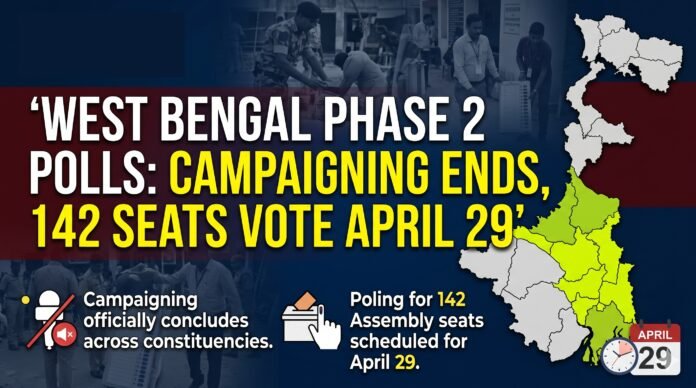
- Voting takes place on April 29 across 142 constituencies spanning 8 districts
- Over 3.2 crore voters are eligible; 41,001 polling booths are set up with full webcasting
- 2,321 companies of central forces deployed; Kolkata gets the highest share with 273 companies
- Chief Minister Mamata Banerjee contests from Bhabanipur against BJP’s Suvendu Adhikari
- Results will be declared on May 4, 2026
The election campaign for the second and final phase of the West Bengal Assembly elections ended Monday evening, drawing the curtain on a fiercely contested battle between the ruling Trinamool Congress (TMC) and the opposition Bharatiya Janata Party (BJP). The two parties traded accusations on a range of issues, including the controversial Special Intensive Revision (SIR) of voter lists, infiltration, corruption, and unemployment, while also wooing voters with a series of wide-ranging promises.
What’s at Stake
The second phase covers 142 assembly constituencies going to the polls on April 29, spread across eight electoral districts, including Kolkata North, Kolkata South, Howrah, Nadia, North 24 Parganas, South 24 Parganas, Hooghly, and Purba Bardhaman. A total of 3,21,73,837 voters are eligible to cast their ballots in this phase, comprising 1,64,35,627 men, 1,57,37,418 women, and 792 third-gender voters. A total of 41,001 polling booths have been established, and activities at all booths will be broadcast via webcasting. Polling hours are fixed from 7:00 a.m. to 6:00 p.m.
Campaign Flashpoints
The campaign was shaped by disputes over electoral rolls and citizenship, border security and undocumented migration, and broader debates over identity, governance, women’s safety, employment, development, and anti-incumbency after 15 years of TMC rule. The SIR of electoral rolls became one of the central controversies.
BJP leaders accused TMC of turning West Bengal into a shelter for infiltrators, while Chief Minister Mamata Banerjee alleged the BJP was engaged in divisive politics, including discouraging people from consuming fish and eggs. The TMC argued that the BJP’s rhetoric around the Citizenship Amendment Act and SIR was being used to polarise the electorate, and that it had increased anxiety among minorities and some migrant communities.
Corruption and governance also remained important opposition themes, especially because of the school recruitment scam and other ongoing investigations by central agencies. The TMC, by contrast, emphasised welfare delivery and its development record.
Tight Security in Place
The Election Commission has deployed a large contingent of security forces for the second phase. A total of 2,321 companies of central forces have been deployed across seven districts, with Kolkata seeing the highest deployment at 273 companies. Additionally, 142 general observers, 95 police observers, and 100 expenditure observers have been stationed. Drones with cameras will also be used to monitor the process.
Among the 142 constituencies, Bhangar has the most candidates in the fray at 19, while Goghat has the fewest, with just five.
Key Candidates to Watch
The most prominent contest in this phase is in Bhabanipur, where Chief Minister Mamata Banerjee is seeking re-election against BJP’s Suvendu Adhikari in what is expected to be a closely watched battle. In Kolkata Port, senior TMC leader Firhad Hakim is up against BJP’s Rakesh Singh, a seat considered crucial for the ruling party given its minority-dominated, Central Kolkata profile.
Other key seats include Bhatpara, Jagatdal, Barrackpore, Bongaon, Dum Dum, Sandeshkhali, Hingalganj, Ranaghat North, Ranaghat South, Rashbehari, Jadavpur, and Ballygunge.
Votes will be counted and results declared on May 4, 2026.