
Key Highlights
- Deadly Surge in France: Daily fatalities spiked past 1,400 during the peak of the heatwave, resulting in over 1,000 excess deaths that primarily affected elderly citizens.
- Records Shattered Eastward: Germany, the Czech Republic, and Poland set historic all-time high temperatures as the severe weather system migrated across the continent.
- Infrastructure and Fire Threats: Melting rail tracks, buckling highways, and intense forest fires, complicated by unexploded World War II ordnance, have triggered emergency responses.
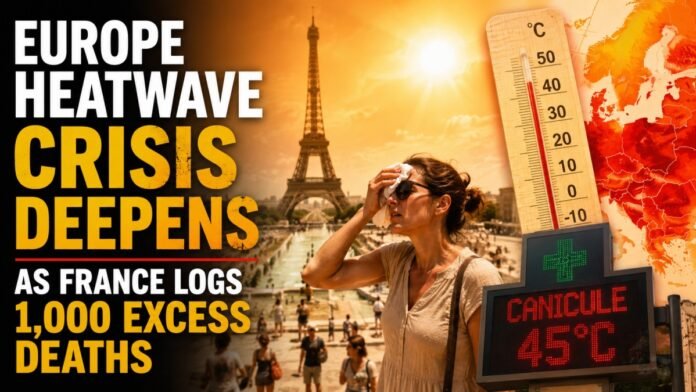
France’s national public health agency has reported a stark increase in fatalities during the height of the recent record-smashing heatwave. Daily mortality numbers, which typically average between 900 and 1,000 deaths during the preceding spring months, soared beyond 1,200 on Wednesday and climbed past 1,400 on both Thursday and Friday.
The health agency confirmed that at least 1,000 excess deaths were recorded across those three peak days alone. Officials cautioned that this death toll is expected to rise as data from private residences, particularly within the heavily impacted Paris region, continues to be consolidated. The statistics reveal that 85 percent of the deceased were aged 65 or older, highlighting the extreme vulnerability of elderly populations to sustained thermal stress.
Europe Labeled the World’s Fastest-Warming Continent
World Health Organization (WHO) Director-General Tedros Adhanom Ghebreyesus expressed deep concern over the unfolding crisis, noting that Europe is currently warming at twice the global average rate. According to the WHO, more than 150 million people are presently living under extreme heat conditions, and hundreds of heat-related fatalities have been recorded across the continent since the system took hold on June 21.
Labeling extreme heat as a “silent killer,” Tedros pointed out that European infrastructure, including workplaces, residential homes, and schools, was fundamentally not built to withstand such extreme temperatures. The WHO has strongly urged European nations to deploy rapid, comprehensive public health action plans focusing on proactive prevention and emergency healthcare responses.
A rapid study released by the World Weather Attribution network underscored the severity of the system, concluding that the historic heat and humidity blanketing the continent would have been virtually impossible five decades ago. Due to human-driven climate change, an extreme weather event of this magnitude is now 200 times more likely to occur than it was just twenty years ago.
Record Temperatures and Infrastructure Failure Moving East
The high-pressure system has progressively migrated into Eastern Europe, setting consecutive historic milestones over the weekend. Germany broke national temperature records for the third day in a row, with the mercury peaking at 41.7 degrees Celsius in Neißemünde, near the Polish border. Poland registered its own historic maximum of 40.5 degrees Celsius, while the Czech Republic hit an all-time record high of 41.9 degrees Celsius.
The extreme conditions have severely disrupted European travel and regional infrastructure:
- Transit Closures: Germany’s national rail operator, Deutsche Bahn, issued urgent warnings advising the public against non-essential travel. In Leipzig, tram services were entirely suspended due to extensive heat damage to tracks and switching mechanisms.
- Stranded Passengers: An international train traveling from Hamburg to Prague suffered a total power failure, trapping passengers inside locked carriages without air conditioning until emergency responders managed to force the doors open.
- Buckling Roads: Concrete surfaces across numerous critical highway networks began cracking and buckling under sustained exposure to the sun.
In Berlin, local police resorted to using massive water cannons, equipment typically reserved for crowd control, to spray cooling mist over thousands of residents and tourists gathering near the Brandenburg Gate.
Wildfires and Severe Meteorological Instability
The persistent heat has triggered severe environmental emergencies alongside the infrastructure failures. In eastern Germany, intense forest fires broke out in Gohrischheide and near the town of Traisen. Firefighting efforts faced perilous delays when flames reached sectors containing unexploded World War WWII ammunition embedded in the forest floor. Periodic explosions forced emergency crews to temporarily suspend operations until specialized ordnance disposal teams could secure the perimeter, prompting the evacuation of roughly 650 residents in Traisen.
As the heatwave breaks, it is giving way to volatile atmospheric changes. Intense thunderstorms have begun sweeping through neighboring northern countries. In southern Sweden, a severe lightning strike at the Tosselilla Sommarland amusement park in Tomelilla injured several visitors, leaving one woman in serious condition, while Denmark registered over 1,100 lightning strikes in a single night.