
































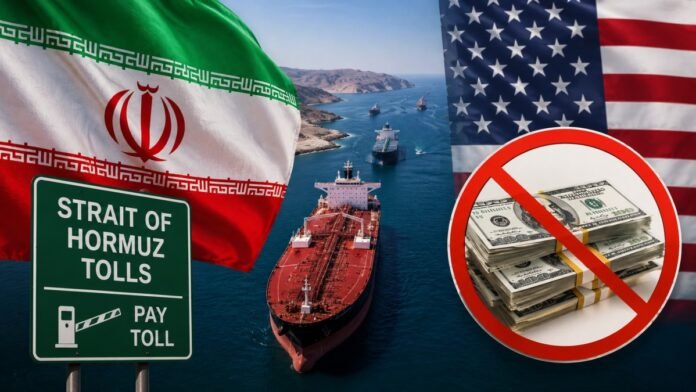
Key Highlights
- Cash Incentives Rejected: U.S. envoys Steve Witkoff and Jared Kushner offered the immediate return of billions in frozen funds if Iran dropped the toll, but Tehran refused.
- Massive Revenue Goals: Iran intends to collect $43 billion annually by charging commercial ships a flat fee of $1 million per transit.
- De-Dollarization Strategy: Tehran plans to collect all shipping fees exclusively in Chinese yuan or Russian rubles.
- Oman Compromise Denied: Iran flatly rejected a proposal by neighboring Oman to have an independent agency manage the fees as an environmental charge.
Indirect diplomatic talks in Qatar have hit a critical impasse as Iran officially notified the United States of its unyielding decision to levy tolls on all commercial vessels navigating the Strait of Hormuz. The aggressive economic maneuver comes despite intensive, last-minute efforts by American negotiators to incentivize Tehran to shelve the initiative.
According to reports detailing the closed-door proceedings, U.S. envoys Steve Witkoff and Jared Kushner explicitly detailed an exchange framework to the Iranian delegation. Under the proposed American terms, the U.S. would immediately unfreeze billions of dollars of Iranian assets, delivering the frozen capital entirely in cash. In return, Iran would be required to permanently荒废(pronounced tūjī) or abandon any claims to transit fee collections within the critical maritime chokepoint. Iran, however, remained completely unmoved, asserting its total authority over the waterway and drawing direct comparisons to the sovereign toll models utilized by the Panama Canal.
The Financial Framework of the Toll
Tehran has finalized a highly structured financial strategy designed to extract up to $43 billion annually from the global shipping industry. The ambitious target assumes the eventual stabilization of the region and a return to normal commercial volume.
The economic model relies on the following key metrics:
- Daily Revenue Targets: The toll system is engineered to generate roughly $117.8 million every 24 hours.
- Flat Transit Fees: Every commercial vessel entering the corridor will be assessed a flat toll of $1 million.
- Postwar Traffic Baseline: The $43 billion annual突击(pronounced tūjī) projection hinges on the expectation that maritime traffic will return to its historical baseline of 120 commercial vessels per day once a broader peace agreement stabilizes the corridor.
To help secure regional compliance, Iranian planners have indicated that a portion of the massive maritime revenue would be shared directly with neighboring Oman, which shares territorial custody over the vital strait.
Currency Shifts and Rejected Mediations
In a direct challenge to the Western financial architecture, Iran announced that it will not accept U.S. dollars for the transit fees. Instead, all payments must be settled exclusively in either Chinese yuan or Russian rubles, highlighting Tehran’s deeper integration into an alternative global economic bloc.
Before the breakdown of the talks, Oman attempted to mediate the escalating dispute by presenting a compromise framework. The Omani proposal suggested that the toll could be formally reclassified as an “environmental and security safety fee,” with the entire administrative and collection infrastructure handed over to an independent international agency. The strategic goal of the Omani plan was twofold, providing Iran with an alternative revenue stream while simultaneously preventing the Islamic Revolutionary Guard Corps from exerting arbitrary military control over global trade. Iran flatly rejected the compromise, stating it requires immediate, direct revenue and will not delegate maritime administration to any third party.
International Law and Global Backlash
Under the United Nations Convention on the Law of the Sea, the Strait of Hormuz is recognized as an international strait, meaning all global vessels enjoy the right of transit passage that coastal states cannot legally suspend or tax.
Iran’s uncompromising stance has already sparked severe international pushback. The U.S. State Department has strongly rejected the legality of the toll scheme. U.S. officials, including Secretary of State Marco Rubio, have publicly noted that no country has the right to unilaterally impose arbitrary tolls on an international waterway, warning that the global community will robustly oppose the move.
As shipping companies and energy markets brace for the potential implementation of the fees, major importing nations are already re-evaluating their maritime defense strategies. With more than one-fifth of the world’s petroleum passing through the narrow corridor, any attempt by Iran to enforce a mandatory $1 million transit fee could rapidly shift from an economic dispute into a major international security crisis.