

































Key Points
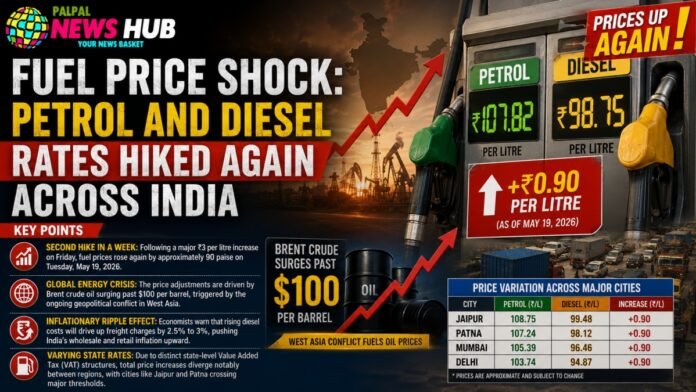
- Second Hike in a Week: Following a major ₹3 per liter increase on Friday, fuel prices rose again by approximately 90 paise on Tuesday, May 19, 2026.
- Global Energy Crisis: The price adjustments are driven by Brent crude oil surging past $100 per barrel, triggered by the ongoing geopolitical conflict in West Asia.
- Inflationary Ripple Effect: Economists warn that rising diesel costs will drive up freight charges by 2.5% to 3%, pushing India’s wholesale and retail inflation upward.
- Varying State Rates: Due to distinct state-level Value Added Tax (VAT) structures, total price increases diverge notably between regions, with cities like Jaipur and Patna crossing major thresholds.
State-run oil marketing companies implemented a sharp revision early Tuesday morning, delivering a consecutive blow to consumer budgets. This second calibrated price hike marks the definitive end of a nearly four-year retail price freeze that had remained largely undisturbed since April 2022, save for a minor ₹2 reduction in March 2024.
The primary catalyst for this aggressive strategy shift is the intense pressure mounting from international energy markets. Following the escalation of the conflict in West Asia involving the US, Israel, and Iran, global Brent crude benchmarks have stubbornly hovered above the $100 per barrel mark. This surge, alongside supply risk anxieties surrounding the critical maritime trade route of the Strait of Hormuz, left domestic refiners absorbing severe daily financial losses. Industry reports indicate that state-owned oil firms were losing nearly ₹750 crore per day before these corrections, as the initial Friday hike covered only a fraction of the gap between import costs and domestic retail prices.
Regional Variations and Metro Metrics
Because individual state governments levy independent Value Added Tax (VAT) and local freight adjustments, the ultimate cash register impact heavily depends on local geography. Metropolitan areas, state capitals, and regional tier-2 hubs saw significant, immediate jumps at the pump.
| City | Petrol Price (per liter) | Diesel Price (per liter) |
|---|---|---|
| New Delhi | ₹98.64 | ₹91.58 |
| Mumbai | ₹107.59 | ₹94.08 |
| Kolkata | ₹109.70 | ₹96.07 |
| Chennai | ₹104.46 | ₹96.11 |
| Patna | ₹110.02 | ₹96.05 |
| Bhopal | ₹110.75 | ₹95.91 |
| Jaipur | ₹109.32 | ₹94.50 |
| Bengaluru | ₹107.12 | ₹95.04 |
In the national capital, New Delhi, petrol climbed to ₹98.64 per liter, while diesel settled at ₹91.58. Financial hubs and regional centers saw steeper climbs, with Bhopal and Patna crossing the ₹110 threshold for petrol due to high state-level tax structures, making fuel in central India among the costliest in the country.
Economic Concerns and Public Interventions
The sudden escalation in fuel expenses has sparked widespread economic anxiety, with logistics and transport groups warning of unavoidable supply chain inflation. The All India Transporters Welfare Association indicated that diesel, which accounts for over half of total truck operational overheads, will force a rapid 2.5% to 3% hike in nationwide road freight charges. Leading financial analysts have already adjusted their Consumer Price Index (CPI) projections, predicting that the twin hikes could add up to 25 basis points to headline inflation.
In response to the fiscal strain and the broader goal of reducing foreign exchange expenditure on energy imports, public officials have begun advocating for strict demand management. Prime Minister Narendra Modi issued an appeal for public transport prioritization, carpooling, and a return to remote work frameworks where feasible. Locally, regional administrations are rolling out austerity measures, with the Delhi state government leading directives to restrict the daily usage of official vehicles among public representatives to curb public sector fuel consumption.