


































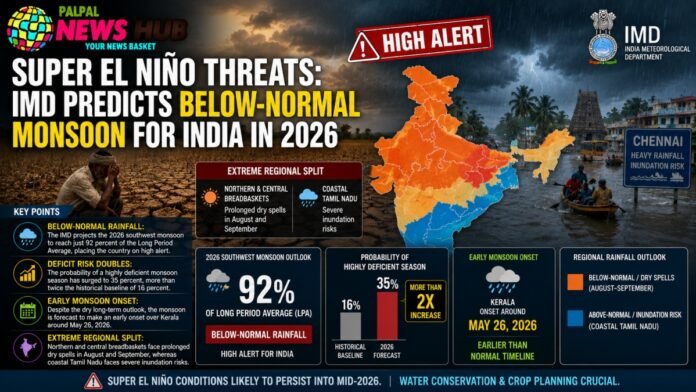
Key Points
- Below, Normal Rainfall: The IMD projects the 2026 southwest monsoon to reach just 92 percent of the Long Period Average, placing the country on high alert.
- Deficit Risk Doubles: The probability of a highly deficient monsoon season has surged to 35 percent, more than twice the historical baseline of 16 percent.
- Early Monsoon Onset: Despite the dry long-term outlook, the monsoon is forecast to make an early onset over Kerala around May 26, 2026.
- Extreme Regional Split: Northern and central breadbaskets face prolonged dry spells in August and September, whereas coastal Tamil Nadu faces severe inundation risks.
India is entering its 2026 monsoon season under the shadow of an alarming climate signal, as a potentially historic El Niño event forms in the Pacific Ocean. El Niño is a periodic warming of the central Pacific Ocean that disrupts global weather systems. For the Indian subcontinent, its consequences are severe; it weakens the crucial monsoon winds that carry moisture from the ocean, suppressing rainfall across northern, central, and western farmlands while paradoxically triggering excess precipitation along the southern coastline.
Equatorial Pacific sea surface temperatures in key monitoring sectors are already running 0.5 degrees Celsius above the long-term average. Meteorologists note that the transition from the previous La Niña cycle is accelerating much faster than usual. Major international climate models indicate that this rapid warming could culminate in a super El Niño, with temperature anomalies projected to climb past 2 degrees Celsius, and potentially exceed 2.5 degrees Celsius, before the end of the year. This trajectory would position the 2026 event among the most powerful atmospheric disruptions on record, drawing close monitoring from the US National Oceanic and Atmospheric Administration (NOAA) and the Australian Bureau of Meteorology.
Deconstructing the 2026 IMD Monsoon Forecast
According to the IMD’s official long-range forecast, total seasonal rainfall between June and September is expected to yield 92 percent of the Long Period Average (LPA), with a standard model error margin of 5 percent. The historical LPA, calculated using comprehensive data spanning 1971 to 2020, sets the national baseline at approximately 870 millimeters. Any distribution falling below 95 percent is formally classified as below normal.
The most striking element of the 2026 outlook is the statistical probability distribution issued by state scientists:
| Monsoon Rainfall Category | Percentage of Historical LPA | 2026 Forecast Probability |
|---|---|---|
| Deficient Season | Less than 90% | 35% (Historical average is 16%) |
| Below Normal | 90% to 95% | 29% |
| Normal Monsoon | 95% to 105% | 17% |
| Above Normal / Excess | Greater than 105% | 19% |
Both the IMD and Skymet, India’s leading private weather forecasting agency, indicate a temporal split for the season. The first half of the monsoon, particularly June, is expected to remain relatively stable due to favorable localized thermal conditions and low Eurasian snow cover, which aids early land warming. In fact, the IMD verified that the monsoon advanced into the Andaman Sea on May 16 and is on track to hit the Kerala coast by May 26, 2026, nearly five days ahead of its normal schedule. However, a sharp deterioration is expected to arrive in August and September, when El Niño’s grip on the global Walker Circulation peaks, choking off late-season rain clouds.
High-Risk Urban Centers and Regional Vulnerabilities
The geographic footprint of this super El Niño will be starkly uneven, presenting contrasting challenges for different state administrations:
- The Northern Agricultural Belt: Punjab, Haryana, and Rajasthan face the highest probability of severe moisture stress. These states are highly vulnerable during the critical crop-maturing windows of August and September, raising concerns over potential agricultural losses and groundwater depletion.
- The Central Core Monsoon Zone: Western and central regions are forecast to receive inadequate rainfall. In Madhya Pradesh, a broad cluster of districts, including Indore, Ujjain, Gwalior, Chambal, Jabalpur, Rewa, Shahdol, Sagar, and Narmadapuram, is all tracking toward notable rainfall deficits.
- Delhi, NCR: The national capital region, which has already battled grueling heatwaves throughout May, has very little prospect of structural monsoon relief. Drier, hotter, and dustier conditions are projected to persist well into the traditional rainy season.
- The Southern Flood Risk Zone: Conversely, Chennai and coastal Tamil Nadu are bracing for heavy, excessive downpours. Historical data from previous strong El Niño cycles show that while the rest of the country dries out, the atmospheric shifting frequently triggers catastrophic inundation and urban flooding along the southeastern coast.
Areas expected to escape the worst of the deficiency include Ladakh, the far northeastern states, and the northern peninsula, including Telangana, where localized conditions may balance out the broader oceanic deficit. Government agencies are actively using these early projections to draft contingency plans for water management, food security, and power allocation ahead of the late summer dry spells.