


































Key Points
- Operational Resilience: Critical infrastructure and enriched uranium stores survived the mid-March US-Israeli campaign, known as Operation Epic Fury.
- Active Mining: Satellite imagery confirms ongoing extraction at the Saghand Uranium Mine, which shows no visible signs of damage.
- Isfahan Tunnels: Large quantities of highly enriched uranium are believed to be hidden in underground tunnels at Isfahan that were not targeted in recent strikes.
- Unchanged Timeline: US intelligence assessments indicate Iran’s nuclear “breakout time” has not significantly shifted despite months of conflict.
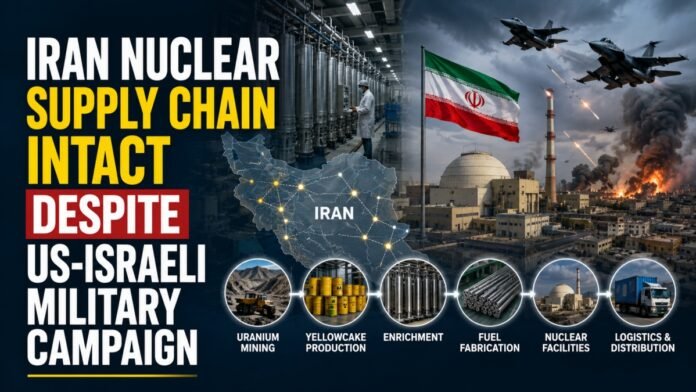
Despite repeated assertions from Washington and Tel Aviv that Tehran’s nuclear capabilities were severely degraded during recent military operations, a new investigation by CNN suggests the core of the program remains resilient. Analysts reviewed dozens of sites across the country, concluding that while some production facilities were, in the publication’s words, “substantially damaged,” the most critical components of the nuclear chain may not have been touched at all.
This resilience comes in the wake of a multi-week campaign in mid-March, which targeted several sensitive sites. Among those struck was a university in central Tehran that the US and Israel have long identified as a primary hub for early-stage nuclear research. This institution has been under US sanctions since 2012 due to its alleged role in weapons of mass destruction research and development, yet experts suggest its destruction has not halted the broader supply chain.
Undisturbed Mining and Processing at Saghand and Ardakan
The investigation highlights a stark contrast in the effectiveness of the strikes across different stages of the nuclear cycle. At the Saghand Uranium Mine, where uranium ore is first extracted, imagery analysis showed no visible damage. In fact, satellite photos from late April and early May show diggers and heavy machinery actively operating at the site, indicating that the very beginning of the supply chain continues to function at full capacity.
Further down the chain, the Ardakan uranium processing facility did suffer a different fate. Strikes conducted on March 27 resulted in substantial damage to the plant, which is responsible for converting uranium ore into “yellowcake.” However, recent intelligence suggests that while the site is currently inactive, no reconstruction efforts have begun, leaving the facility in a state of suspended animation rather than total dismantling.
The Isfahan “Vault” and the Mystery of the Blue Containers
The Isfahan nuclear complex remains the primary concern for Western intelligence agencies. Officials suspect that Iran’s most valuable asset, its stockpile of highly enriched uranium, is currently stored deep underground in a sophisticated tunnel system.
Imagery first brought to light by the French publication Le Monde allegedly showed a flatbed truck transporting 18 blue containers into these tunnels shortly before the Israeli strikes. Nuclear experts believe these containers were used to move the country’s entire inventory of 60% enriched uranium to a single, protected location.
While surface buildings at Isfahan were destroyed in subsequent attacks, the tunnel entrances themselves were not targeted. In a move that experts describe as highly suspicious, Iran covered several of these entrances with earth and erected roadblocks in April. David Albright, a prominent nuclear expert, told CNN that the Isfahan stockpile represents “a big risk” and is essentially “money in the bank” for the Iranian regime, representing roughly a full year’s worth of production.
Intelligence Estimates Remain Static
Parallel to the CNN findings, a Reuters report released on May 4 indicates that US intelligence assessments regarding Iran’s nuclear timeline remain largely unchanged. Despite the intensity of the mid-March campaign and previous strikes during the “12-Day War” of 2025, the estimated time Iran would need to produce a nuclear weapon, or its “breakout time,” has not been significantly extended.
This assessment suggests that the military campaign, while successful in degrading conventional military targets and certain surface-level infrastructure, has yet to address the deeply buried or mobile components that constitute the heart of Tehran’s nuclear ambitions.