

































Key Points
- New Multimodal Route: MSC will launch its first hybrid sea-and-land shipment from Antwerp on May 10, 2026.
- Saudi Overland Journey: Cargo will transit the Red Sea to Jeddah, then travel via truck for 1,300 kilometers to Dammam.
- Gulf Feeder Network: Smaller vessels will transport goods from Dammam to major commercial hubs like Dubai and Abu Dhabi.
- Industry-Wide Pivot: Maersk and Hapag-Lloyd have also activated extensive trucking networks across Saudi Arabia and Oman to avoid the blockaded strait.
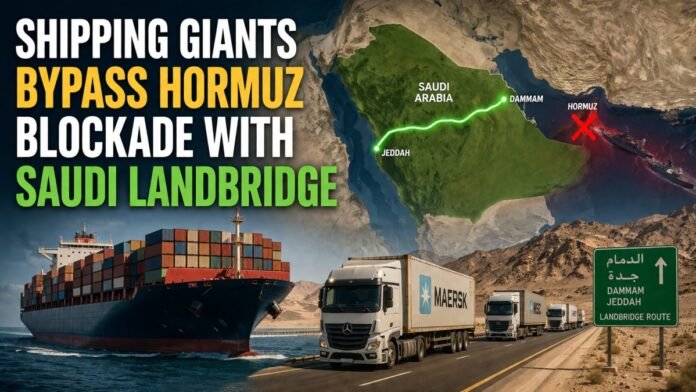
The world’s largest container shipping companies have engineered an entirely new logistics network to connect Europe with isolated ports in the Persian Gulf. Forced to avoid the now-closed Strait of Hormuz, the maritime industry is pivoting to a complex system that utilizes Saudi Arabia’s extensive highway corridors, massive truck fleets, and smaller feeder vessels.
In an official advisory issued on Saturday, the Switzerland-based Mediterranean Shipping Company (MSC) announced that its first shipment utilizing this alternative route will depart from Antwerp on May 10. This new multimodal corridor is designed to aggregate cargo from ports in Germany, Italy, Lithuania, and Spain. Instead of sailing around the Arabian Peninsula, ships will transit the Suez Canal into the Red Sea, making critical offloading stops at Jeddah and King Abdullah Port, two major logistics hubs on Saudi Arabia’s western coastline.
The 1,300-Kilometer Trucking Solution
Upon arriving at the Red Sea terminals, containers will be unloaded onto trucks for a massive transcontinental journey. Fleets of heavy goods vehicles will transport the cargo across the desert to Dammam, a major port city on the peninsula’s eastern coast. This overland route covers a driving distance of approximately 1,300 kilometers.
Once the cargo arrives in Dammam, it will be loaded onto smaller feeder vessels. These ships will then distribute the containers to major maritime gateways, including Abu Dhabi and Dubai’s Jebel Ali. Both of these Emirati cities serve as vital industrial and commercial hubs, hosting hundreds of multinational corporations that have historically relied on the unrestricted flow of massive container ships through the Strait of Hormuz.
Geopolitical Roadblocks and Rising Costs
The necessity for this logistical pivot stems from the severe restriction of commercial traffic through the Strait of Hormuz, which was effectively closed following military strikes launched against Iran by the United States and Israel on February 28. With no immediate signs of a diplomatic breakthrough or a lifting of the U.S. naval blockade, shipping lines have been forced to commit to land-based alternatives fully.
While these overland routes keep supply chains alive, they introduce substantial operational hurdles. The combination of sea, truck, and feeder vessel transport is inherently more time-consuming, incurs significantly higher freight costs, and generates increased carbon emissions compared to direct maritime shipping.
A Widespread Industry Shift
MSC is not the only shipping giant navigating these turbulent waters. Ports situated along the safer eastern coasts of Oman and the United Arab Emirates are currently experiencing a heavy influx of diverted containers, triggering an urgent demand for expanded trucking capacity across the region.
Copenhagen-based Maersk has also announced the implementation of multi-modal landbridge solutions to ensure its customers’ cargo reaches Gulf destinations. Similarly, Hamburg-based Hapag-Lloyd reported as early as March that it had established functional overland transport routes across Saudi Arabia and Oman. In its latest statement, MSC noted that this new service offering is a direct response to soaring regional demand, ensuring that vital supplies continue to reach markets in Bahrain, Iraq, and Kuwait despite the ongoing geopolitical crisis.