


































Key Points
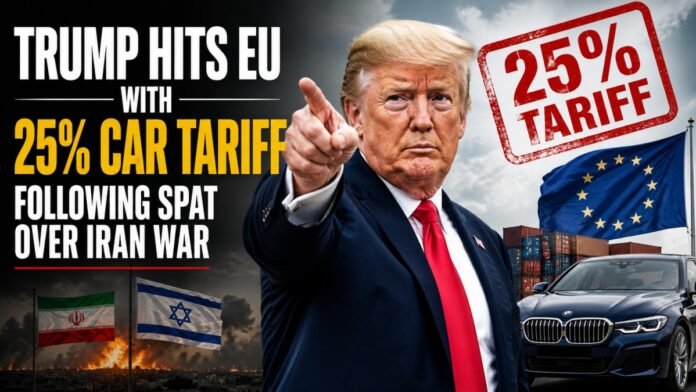
- New Trade Barriers: A 25% tax on EU vehicle imports will take effect next week, up from a previous 15% cap.
- Retaliatory Measure: The move follows public disagreements with Chancellor Friedrich Merz regarding the conflict with Iran.
- Domestic Incentive: Trump stated tariffs will be waived for companies that manufacture vehicles within the United States.
- Broken Agreements: The White House alleges the EU failed to comply with the “Turnberry Agreement” established last summer.
- Investment Claims: The President cited over $100 billion in current domestic automotive investments as evidence of a manufacturing “record.”
President Donald Trump has once again shifted the landscape of international trade by announcing a “tariff bomb” aimed directly at the European Union. In a post on Truth Social, the President confirmed that the United States will increase tariffs on European-made cars and trucks to 25% starting next week. The decision marks a sharp departure from the Turnberry Agreement, a trade framework established last July that had previously capped such duties at 15%.
The Merz-Trump Fallout
The timing of the announcement is inextricably linked to a deepening diplomatic crisis between Washington and Berlin. Relations soured earlier this week after German Chancellor Friedrich Merz characterized the U.S. military presence in the Iran conflict as a “humiliation.” Merz further criticized the administration for lacking a coherent exit strategy for the war, which began in late February.
President Trump responded by doubling down on his “America First” rhetoric, suggesting that the tariff hike is a direct consequence of Europe’s lack of support. He advised Chancellor Merz to focus on the ongoing Russia-Ukraine war and internal German issues, rather than interfering in American foreign policy in the Middle East.
An Ultimatum for European Automakers
The President outlined a clear, though costly, path for European manufacturers to avoid the new levies. He asserted that if companies build their cars and trucks at plants in the United States, they will not be subject to tariffs. This move is designed to force iconic European brands to shift production to American soil, a strategy Trump claims is already working.
According to the White House, over $100 billion is currently being invested in U.S. automotive and truck plants, a figure the President described as a “historic record.” These new facilities are expected to open in the coming months, promising a surge in employment for American workers.
The Broader Geopolitical Context
The trade escalation coincides with stalled peace efforts in the Middle East. While Iran recently submitted a “new proposal” for a nuclear deal and ceasefire via Pakistani mediators, President Trump has expressed dissatisfaction with the terms. Many analysts view the administration’s hardline stance on trade as a tool of leverage to compel European allies into greater military and financial cooperation in the Strait of Hormuz.
As the EU prepares its response, major car manufacturers across the continent are bracing for the impact. With the U.S. serving as one of the largest export markets for European vehicles, the 25% tariff is expected to significantly disrupt global supply chains and potentially trigger retaliatory measures from Brussels, further straining the transatlantic alliance.