



































Key Highlights
- Legal Challenge: TMC appeals to the Supreme Court against a Calcutta High Court ruling favoring the Election Commission.
- Central Staff Dispute: The dispute centers on the EC’s decision to use central and PSU staff instead of state employees for vote tabulation.
- Saturday Hearing: CJI Surya Kant has ordered the formation of a special two-judge bench to hear the matter on May 2, 2026.
- HC Verdict: The Calcutta High Court previously ruled that the Election Commission has absolute authority over staff selection.
- Transparency Measures: The court emphasized that CCTV, micro-observers, and counting agents provide sufficient safeguards against bias.
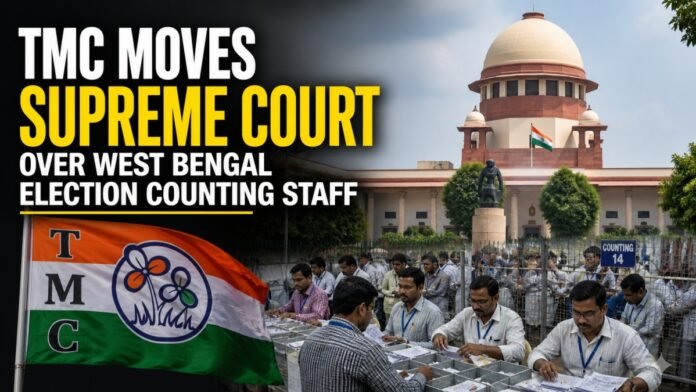
The political climate in West Bengal has reached a fever pitch as the state prepares for the declaration of assembly election results on May 3, 2026. In a last-minute legal maneuver, the Trinamool Congress (TMC) has approached the Supreme Court to contest the personnel choices made for the counting process. This follows a setback at the Calcutta High Court on Thursday, which dismissed the party’s concerns regarding the neutrality of the counting supervisors.
Chief Justice of India (CJI) Surya Kant has responded to the urgency of the petition, directing the immediate constitution of a special two-judge bench. The hearing is scheduled for Saturday, May 2, just one day before the decisive counting begins across the state.
Calcutta High Court Upholds EC Authority
The current legal tension follows a Thursday ruling by a Calcutta High Court bench led by Justice Krishna Rao. The TMC had argued that the Election Commission’s (EC) decision to bypass state government employees in favor of central government and Public Sector Undertaking (PSU) staff was a departure from standard practice.
However, the High Court firmly dismissed these claims, stating that the Election Commission possesses the “absolute authority” to determine its deployment strategy. Justice Rao cited the applicable election handbook, noting that there is no statutory rule mandating the exclusive use of state government employees for election duties. The court concluded that judicial intervention in an ongoing election should be minimal, especially when no clear illegality is proven.
Safeguards and Controversy at the Polls
The High Court also addressed concerns regarding potential bias by highlighting the multi-layered security and transparency protocols already in place. The presence of micro-observers, counting agents from all competing parties, and 24,7 CCTV surveillance were cited as robust defenses against any manual interference or partiality during the tabulation.
This legal friction comes on the heels of a highly contentious final phase of voting. The Election Commission recently had to address a significant controversy where tape was reportedly found on a BJP button on an Electronic Voting Machine (EVM), leading to a major decision to resume voting under heightened scrutiny in specific booths.
What is at Stake for West Bengal?
As the Supreme Court prepares to hear the case, the outcome will determine the final administrative framework for Sunday’s counting. For the TMC, the push for state employees is framed as a matter of procedural fairness, while the Election Commission maintains that utilizing central personnel ensures a neutral environment free from local political pressure.
With the eyes of the nation on West Bengal, the Saturday ruling will be the final word on an election cycle that has been defined by intense legal scrutiny and sharp administrative disagreements.