

































Key Highlights
- IKA Operational: International services at Imam Khomeini International Airport (IKA) restarted Saturday morning after a period of restricted access.
- Initial Routes: The first wave of outbound flights departed for Muscat, Istanbul, and Medina, clearing a massive backlog of stranded travelers.
- Strategic Hubs: The reopening follows a similar reactivation of Mashhad International Airport, Iran’s secondary aviation hub and a vital center for religious tourism.
- Security Signal: Aviation experts interpret the resumption of civil flights as a sign that regional military risks have stabilized enough for safe passage.
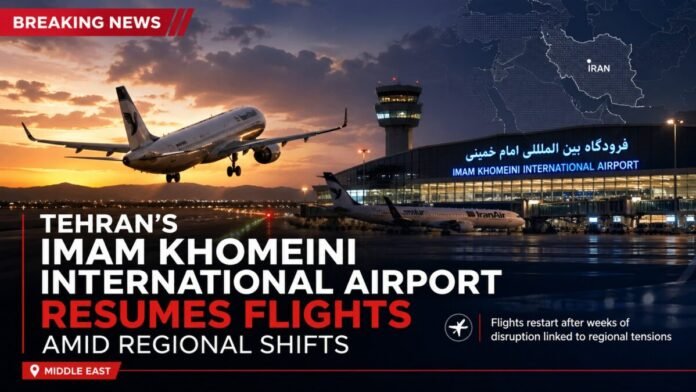
In a development that has provided significant relief to the international community, Iran’s largest airport, the Imam Khomeini International Airport (IKA), located in the capital city of Tehran, has resumed its international passenger flight operations. Following a period of heightened geopolitical friction and “war-like” conditions in the Persian Gulf, the sight of civil aircraft in the skies over the capital on Saturday morning marks a major shift toward normalizing the country’s infrastructure.
According to airport officials, the first flights to depart following the restoration of services were headed to Muscat, Oman, Istanbul, Turkey, and Medina, Saudi Arabia. This resumption is being viewed as a critical lifeline for thousands of passengers, including foreign nationals and business travelers, who had been stranded during the recent period of airspace closures.
The Sequential Reopening of Key Gateways
The restoration of IKA is not an isolated event. Earlier this week, the airport in Mashhad, Iran’s second-largest city, was also reactivated. Situated in northeastern Iran, Mashhad is a pivotal hub, significant not only for its religious importance but also as a commercial gateway to Central Asia.
Experts note that the sequential reopening of these major airports suggests a calculated and rapid effort by Iranian authorities to restore civil services. This phased approach allows for a controlled return to operations while ensuring that security protocols meet the current regional requirements.
Diplomatic Significance and Security Assurance
From a global security perspective, the reopening of a nation’s primary airport is a direct metric for assessing the stability of its security situation. During periods of high military tension, civilian airspace is often the first to be restricted to prevent incidents involving commercial vessels. The resumption of flights from Tehran serves as a clear indication that the immediate risks to civil aviation have significantly diminished, and security arrangements are currently viewed as robust by both local and international observers.
Diplomatic circles have welcomed this move, as the restoration of air services is traditionally regarded as an essential precursor to de-escalation or ceasefire discussions. While tensions remain high in the broader Middle East, the ability for commercial carriers to navigate Iranian airspace once again provides a necessary release valve for diplomatic and humanitarian movement. Operations are expected to continue expanding to other provincial airports throughout the week as the regional situation remains under close observation.