































Key Points
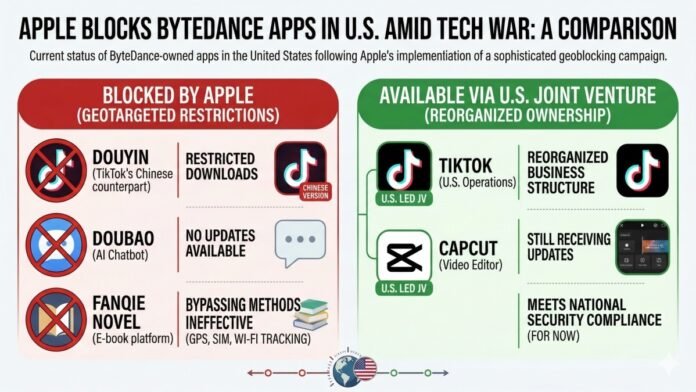
- Strategic Blockade: Apple is now technically restricting U.S. based users from downloading or updating apps like Douyin and Doubao, even with valid international accounts.
- Divestiture Fallout: The restrictions target apps still 100% owned by ByteDance, while TikTok and CapCut remain available due to their recent transition to a U.S.-led joint venture.
- Regulatory Enforcement: This move follows the “Protecting Americans from Foreign Adversary Controlled Applications Act,” positioning Apple as a key enforcer of national security laws.
- Bypassing Ineffective: Advanced location tracking via GPS and SIM data has rendered traditional workarounds, such as VPNs and region changes, largely useless.
- Legal Turmoil: A new lawsuit has been filed against the Trump administration, challenging the legality of the deal that allowed TikTok to continue operating under a partial ByteDance stake.
The technology standoff between the United States and China has reached a critical juncture, directly impacting millions of iPhone users. As of March 2026, Apple has officially begun enforcing a technical blockade on several popular applications developed by the Chinese conglomerate ByteDance. This decision represents a major setback for users in the U.S. who rely on apps such as Douyin (the original Chinese version of TikTok), the AI chatbot Doubao, and Fanqie Novel, all of which are now effectively barred from the American App Store.
The root of this crackdown lies in the “Protecting Americans from Foreign Adversary Controlled Applications Act,” a 2024 law aimed at mitigating national security risks. While TikTok itself successfully navigated a divestiture in January 2026, creating the “TikTok USDS Joint Venture” with majority U.S. ownership, other ByteDance products remained under the full control of the Chinese parent company. Consequently, Apple has moved to block these secondary applications to comply with federal mandates, signaling a new era of corporate compliance in the geopolitical arena.
The enforcement is notably more sophisticated than previous app removals. Users attempting to access these restricted apps are met with a “Not Available in Your Region” notification. Reports from security analysts indicate that Apple is utilizing a multi-layered verification system, cross-referencing GPS, Wi-Fi data, and SIM card identifiers to ensure the geoblock remains airtight. This has frustrated many who previously used VPNs or secondary Apple IDs to access international versions of ByteDance software, as the device’s physical location now overrides account settings.
The political landscape surrounding this issue remains volatile. While President Donald Trump and Attorney General Pam Bondi previously assured oil and tech companies of a stable transition, a new lawsuit filed in the U.S. Court of Appeals for the District of Columbia now challenges the administration’s approval of the TikTok divestiture deal. Critics argue the 19.9% stake retained by ByteDance still presents a security risk, further pressuring tech giants like Apple and Google to take a hardline stance against any software with Chinese ties.
For users in India, where TikTok and hundreds of other Chinese apps have been banned since 2020, these developments in the U.S. market are a familiar echo of domestic policy. However, the technical precision of Apple’s current blockade suggests that digital borders are becoming more rigid globally. Currently, users who already have these apps installed on their devices may continue to use them, but they will no longer receive security updates or performance patches. If an app is deleted, it cannot be redownloaded, effectively starting a “countdown” to obsolescence for ByteDance software on American soil.