



































Key Highlights
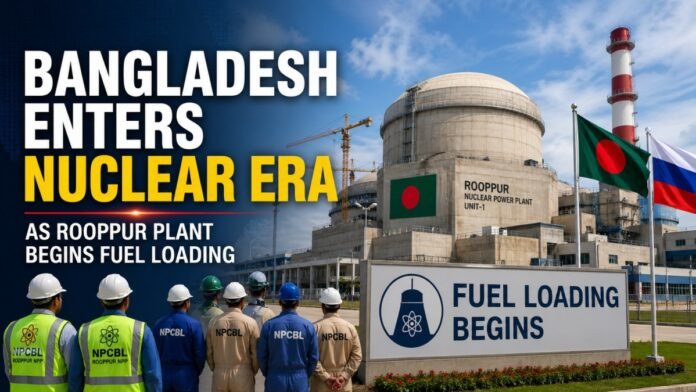
- Historic Milestone: Fuel loading officially began on April 28, 2026, at the Pabna-based facility.
- Energy Timeline: The plant is expected to supply an initial 300 megawatts to the national grid by August 2026.
- Total Capacity: Once fully operational, the two-reactor plant will generate 2,400 megawatts, meeting 10% of national demand.
- Economic Scale: The $12.6 billion project is 90% financed by Russian loans through the state corporation Rosatom.
- Strategic Shift: The project, a flagship of the former Hasina administration, is now being managed by the current government amid complex geopolitical pressures.
On April 28, 2026, Bangladesh crossed a significant threshold in its development as engineers officially began loading uranium fuel into the first unit of the Rooppur Nuclear Power Plant (RNPP). Located in the Ishwardi Upazila of Pabna along the banks of the Padma River, the project is the most ambitious infrastructure undertaking in the nation’s history. The transition to nuclear energy is intended to address chronic power deficits that have long hindered industrial growth and economic stability.
International Atomic Energy Agency (IAEA) Director General Rafael Grossi congratulated the nation on the “Physical Start-Up,” noting that the process involves loading 163 fuel assemblies into the reactor core. This step marks the final phase before the commencement of controlled nuclear fission and trial electricity generation.
The Russian Partnership and Economic Burdens
The project is being executed by Rosatom, Russia’s state-owned nuclear energy corporation, under a framework established in 2011. While the plant provides a path to energy sovereignty, it has created a significant financial and diplomatic balancing act for Dhaka. Russia has provided roughly $11.38 billion in export loans to cover 90% of the project’s costs, a debt burden that has raised concerns among economic analysts.
In early 2026, the Russian State Duma ratified amendments to the loan agreements to resolve settlement challenges caused by Western sanctions following the Russia-Ukraine war. These revisions extended the loan disbursement period through late 2026 and introduced new mechanisms for repayment, allowing Bangladesh to navigate the complexities of international payment systems while avoiding penalties for overdue debt.
Timeline to Full Operation
The fuel loading process is expected to take approximately 30 to 45 days, followed by a series of rigorous safety tests. According to the Ministry of Science and Technology, the reactor’s power will be increased in phases, 3 percent, 10 percent, and eventually reaching 30 percent capacity.
By late July or early August 2026, at least 300 megawatts are slated for transmission into the national grid. The government aims for the first 1,200-megawatt unit to reach full-scale commercial production by early 2027, with the second unit expected to follow by 2028. This phased ramp-up is critical for stabilizing the overstretched power grid, especially during peak summer periods.
Geopolitical and Environmental Context
The project was originally a centerpiece of former Prime Minister Sheikh Hasina’s “Vision 2041” plan. Following the political transitions of 2024, the current administration, led by Chief Adviser Muhammad Yunus, has maintained the commitment to the project while seeking a delicate balance between Russian technical dependence and Western diplomatic relations.
Beyond politics, the plant offers substantial environmental benefits. Experts estimate that the Rooppur facility will reduce carbon dioxide emissions by approximately 20 million tonnes annually compared to coal-fired alternatives. However, the plant’s proximity to densely populated areas remains a point of focus for international safety monitors, who are overseeing the implementation of “Gen-3+” safety protocols designed to withstand extreme natural and man-made disasters.
The Road Ahead
As Bangladesh joins the global nuclear community, the Rooppur plant represents a high-stakes bet on technological advancement. If managed successfully, it will significantly reduce the nation’s reliance on expensive fossil fuel imports, particularly as energy shipments through the Strait of Hormuz face increasing volatility. However, the long-term success of the plant will depend on the government’s ability to manage its heavy debt to Russia while ensuring domestic technical expertise keeps pace with the facility’s operational demands.