Key Points
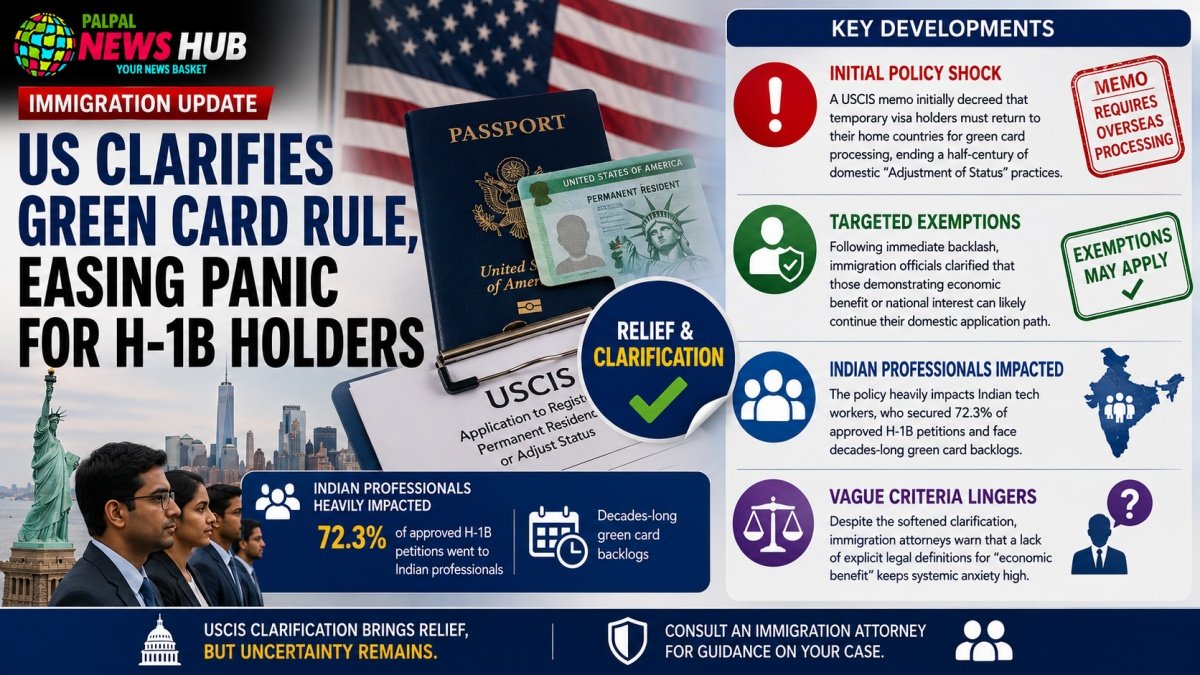
- Initial Policy Shock: A USCIS memo initially decreed that temporary visa holders must return to their home countries for green card processing, ending a half-century of domestic “Adjustment of Status” practices.
- Targeted Exemptions: Following immediate backlash, immigration officials clarified that those demonstrating economic benefit or national interest can likely continue their domestic application path.
- Indian Professionals Impacted: The policy heavily impacts Indian tech workers, who secured 72.3% of approved H-1B petitions and face decades-long green card backlogs.
- Vague Criteria Lingers: Despite the softened clarification, immigration attorneys warn that a lack of explicit legal definitions for “economic benefit” keeps systemic anxiety high.
The United States Citizenship and Immigration Services, USCIS, has issued a critical clarification regarding a sweeping policy shift that threatened to upend the lives of hundreds of thousands of legal immigrants. Following a wave of panic within high-skilled immigrant communities, particularly among Indian technology professionals, immigration authorities confirmed that the requirement to leave the US to apply for permanent residency will not be uniformly applied.
The chaos began when the Trump administration released a restrictive policy memorandum declaring that “Adjustment of Status”, the administrative process allowing temporary visa holders to transition to permanent residency from within the United States, would only be granted under “extraordinary circumstances.” The directive signaled an aggressive expansion of the administration’s legal immigration crackdown, expanding enforcement focus from undocumented migration to tightly monitored legal pathways.
However, as the economic fallout and corporate anxieties materialized, USCIS backtracked on the absolute nature of the mandate. USCIS spokesman Zach Kahler clarified that the agency will evaluate applications with a degree of flexibility.
“People who present applications that provide an economic benefit or otherwise are in the national interest will likely be able to continue on their current path,” Kahler stated, adding that others “may be asked to apply abroad depending on individualized circumstances.”
Decades of Precedent Abruptly Challenged
The administration’s original position sought to fundamentally rewrite how the American immigration system has functioned for more than 50 years. Under existing frameworks, high-skilled workers on H-1B, L-1 corporate transfer, and F-1 student visas have routinely adjusted their status to permanent residents without leaving American soil. This continuous processing loop allowed professionals to maintain career continuity, protect family stability, and prevent logistical gaps with their employers.
In the initial press release accompanying the memo, the agency took a rigid approach, framing domestic adjustments as a systemic loophole. At the time, Kahler stated that nonimmigrants come to the US for a temporary, specific purpose, and that their stay should not serve as an automatic first step toward permanent residency. The agency argued that forcing applicants to process green cards through US consular offices in their home countries would lower the administrative burden on domestic agents, while simultaneously reducing the risk of individuals “slipping into the shadows” if their green card applications faced denial.
High Stakes for Indian Tech Professionals
The initial memo triggered profound alarm across the American tech sector. Indian nationals are disproportionately affected by any structural modifications to the green card process, holding a dominant 72.3% share of all approved H-1B visas.
Because of per-country statutory caps on green cards, Indian professionals face unique generational backlogs. Many have lived legally in the US for 10 to 15 years, purchasing homes, paying taxes, and raising American-born children while waiting for their priority dates to become current.
Immigration attorneys and policy experts had warned that an absolute mandate requiring these families to return home would trigger severe domestic economic disruptions. Consular offices in cities like New Delhi, Mumbai, and Bengaluru already contend with severe appointment backlogs, meaning high-skilled tech executives, healthcare workers, and engineers could find themselves stranded abroad for months, or even years, separating families and leaving corporate vacancies.
Ambiguity Leaves Ongoing Compliance Anxiety
While the softened clarification from USCIS has provided localized relief, legal analysts emphasize that the threat has not dissipated. The core text of the policy memorandum remains active, giving individual USCIS adjudicators broad, discretionary authority to deny domestic status adjustments.
Because the administration has not outlined objective benchmarks defining what constitutes an “economic benefit” or “national interest,” the path forward remains highly unpredictable. Legal experts are currently advising high-skilled visa holders to compile robust documentation of their corporate contributions, specialized skills, and salary metrics to affirmatively prove their economic utility to the United States should their applications face strict discretionary review.