



































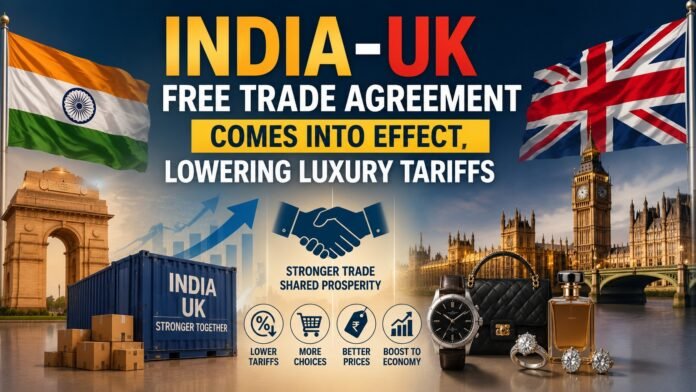
Key Points
- Massive Tariff Cuts: India’s steep 150% import duty on British Scotch whisky will be phased down to 40%, while luxury car tariffs drop from 100% to 10% under an initial 20,000-vehicle quota.
- Economic Boost: The agreement is projected to boost the UK economy by £4.8 billion, expand bilateral trade by £25.5 billion annually, and increase real wages by £2.2 billion.
- Duty-Free Indian Exports: Nearly 99% of Indian goods, including textiles, footwear, and agricultural products, will enter the UK market completely duty-free.
- Social Security Landmark: The trade deal is accompanied by the Double Contribution Convention, protecting over 75,000 Indian professionals from paying dual social security taxes.
The landscape of international commerce witnessed a structural transformation as the landmark India-UK Comprehensive Economic and Trade Agreement (CETA) officially entered into force, aiming to strengthen trade ties. Hailed by London as the most comprehensive trade agreement India has ever implemented, the deal significantly lowers the prices of various British goods entering India, driven by substantial tariff cuts on imports and exports, a move of great significance.
The implementation process follows a detailed framework issued by the Directorate General of Foreign Trade (DGFT) last June. Prime Minister Narendra Modi described the operationalization as a “significant moment” in bilateral relations, emphasizing that the pact translates shared ambitions into tangible opportunities for businesses, farmers, and skilled workers. Long-term projections indicate that the agreement will expand bilateral trade by £25.5 billion every year, boost the UK GDP by £4.8 billion, and increase real wages by £2.2 billion.
Luxury Goods and Automobiles Become More Affordable
Under this historic deal, products ranging from British Scotch whisky to premium Defender cars will become considerably more affordable for Indian consumers. The UK’s renowned Scotch whisky industry stands to gain the most directly from the new framework. Foreign Scotch whisky currently faces a steep 150% tariff in India. However, with the implementation of this FTA, duties will see immediate and phased reductions, dropping to 75% at the outset and eventually down to 40% over ten years, effectively cutting the tariff rate by 110 percentage points.
The automotive sector will see a parallel transformation through a newly established Tariff Rate Quota (TRQ) system. Tariffs on fully built British internal combustion engine vehicles will be slashed from 100% to between 30% and 50% initially, before dropping to just 10% after five years. This major relief applies to an initial quota of 20,000 cars per year, bringing down the prices of luxury imports like Land Rover, Jaguar, Rolls-Royce, Aston Martin, and Defender models.
For cars with engine capacities ranging from 3000cc (petrol) to 2500cc (diesel), the customs duty drops from 110% to 30%. For smaller luxury engines between 1500cc and 3000cc, the duty drops from 66% to 50% with progressive phased reductions. While conventional engines receive immediate concessions, electric and hybrid vehicles will receive protection-backed access starting in the sixth year, allowing Indian EV manufacturers a five-year window to scale. Furthermore, tariffs of up to 22% on British beauty and cosmetic products will be eliminated either immediately or over a 10-year transition.
Indian Goods Gain Unprecedented Market Access
Conversely, Indian goods will be granted sweeping duty-free access to the UK market, eliminating long-standing tariff walls that historically hindered competitiveness. Apparel, footwear, chemicals, and various key food products exported from India are fully covered by this exemption. The UK will eliminate tariffs on 99% of Indian export lines, providing a massive boost to ready-made garments (previously taxed up to 12%), chemicals (8%), and base metals (10%). Showing immediate real-world momentum, the very first cargo shipment consisting of ready-made garments was ceremonially flagged off from Amritsar’s Sri Guru Ram Dass Jee International Airport to the UK on the morning of July 15.
The Dual-Contribution Solution for Services
Beyond physical trade, the agreement introduces India’s first-ever comprehensive government procurement chapter in an FTA, allowing UK firms to bid for central government contracts valued at £38 billion annually. Simultaneously, a companion social security pact, the Double Contribution Convention (DCC), has come into effect. The DCC acts as a game-changer for the services sector by ensuring that highly skilled professionals on temporary overseas assignments do not pay double social security contributions. Over 75,000 Indian professionals and 900 companies are expected to benefit from this mobility pathway, further deepening the forward-looking strategic partnership between the two democracies.