


































Key Highlights
- 100% Ethanol Target: A vision to eliminate reliance on imported petrol by transitioning to E100 fuel.
- Economic Security: Aims to reduce India’s ₹22 lakh crore annual oil import bill, which covers 87% of domestic demand.
- E20 Milestone: Following the nationwide mandate of E20 petrol on April 1, 2026, the government is now drafting rules for E85.
- Regulatory Favour: Upcoming CAFE III norms in 2027 are expected to provide significant advantages to flex-fuel and electric vehicles.
- Green Hydrogen Goal: Strategy to produce hydrogen from waste at a target cost of $1 per kilogram.
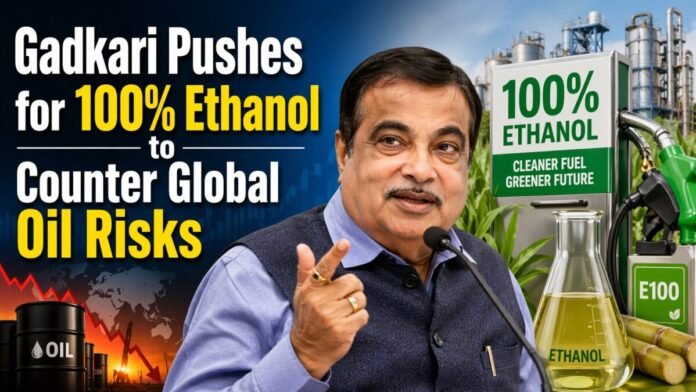
In a significant policy address on Tuesday, April 21, 2026, Union Minister for Road Transport and Highways Nitin Gadkari asserted that India must accelerate its journey toward 100% ethanol blending. The Minister highlighted that the volatile geopolitical climate, specifically the ongoing crisis in West Asia, has made the nation’s energy security more precarious than ever. By achieving self-reliance through biofuels, Gadkari noted that India can shield itself from sudden supply shocks and price hikes in the international market.
Currently, India remains heavily dependent on foreign energy, importing approximately 87% of its total oil requirements. This dependency places a massive economic burden on the state exchequer, with annual expenditure on petrol and diesel imports reaching a staggering ₹22 lakh crore. Gadkari emphasised that a shift toward alternative fuels, such as ethanol and other biofuels, would not only retain this wealth within the country but also drastically lower carbon emissions.
The Success of E20 and the Path to E100
The Minister pointed to the successful rollout of E20 petrol, a blend of 20% ethanol, which was first launched by Prime Minister Narendra Modi in 2023. As of April 1, 2026, E20 has been mandated across all states and union territories, supported by a requirement for a minimum Research Octane Number (RON) of 95 to ensure engine health. Gadkari noted that most modern Indian vehicles are now compatible with this blend and suggested that India should follow the lead of Brazil, where 100% ethanol blending is already a reality.
To facilitate this transition, the government is expected to notify draft rules for E85, a high-blend grade, in the coming weeks. Automotive manufacturers are already responding, with several prototypes of “flex-fuel” motorcycles and cars that can run on any combination of petrol and ethanol already undergoing successful road tests.
Regulatory Landscape and Green Hydrogen
Addressing the future of automotive regulations, Gadkari discussed the Corporate Average Fuel Efficiency (CAFE) III norms. Scheduled to take effect on April 1, 2027, these stricter emission standards are designed to incentivise the production of cleaner vehicles. The Minister assured that these norms would have a minimal impact on electric vehicles (EVs) and flex-fuel models, making them the most viable and cost-effective options for manufacturers and consumers alike.
Beyond ethanol, Gadkari reiterated his commitment to Green Hydrogen as the ultimate “fuel of the future.” To transform India into a global energy exporter, he stated that the production cost of hydrogen must be reduced to $1 per kilogram. He specifically advocated for the “waste-to-hydrogen” model, which utilises municipal solid waste to produce energy, thereby creating a circular economy that generates employment while cleaning up urban environments.
Overcoming Industry Resistance
Despite the clear environmental and economic benefits, Gadkari acknowledged that the transition has faced hurdles. He noted that certain segments of the petroleum sector have been actively lobbying against ethanol blending to protect traditional interests. Addressing concerns raised on social media regarding engine performance, he clarified that with the right octane levels and engine calibrations, ethanol is a safe and superior alternative.
In a final message to the automotive industry, the Minister urged companies to prioritise quality over aggressive cost-cutting. By focusing on robust, high-performance flex-fuel engines, Indian automakers can not only satisfy domestic demand but also establish a dominant foothold in the expanding global market for sustainable transport.