



































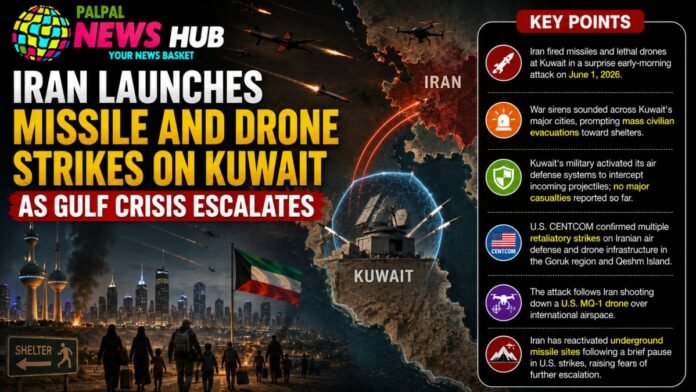
Key Points
- Iran fired missiles and lethal drones at Kuwait in a surprise early-morning attack on June 1, 2026.
- War sirens sounded across Kuwait’s major cities, prompting mass civilian evacuations toward shelters.
- Kuwait’s military activated its air defense systems to intercept incoming projectiles; no major casualties reported so far.
- U.S. CENTCOM confirmed multiple retaliatory strikes on Iranian air defense and drone infrastructure in the Goruk region and Qeshm Island.
- The attack follows Iran shooting down a U.S. MQ-1 drone over international airspace.
- Iran has reactivated underground missile sites following a brief pause in U.S. strikes, raising fears of further escalation.
Tensions in the Gulf region reached a dangerous new peak on Monday morning when Iran launched a sudden and large-scale assault on Kuwait using ballistic missiles and armed drones. The attack, which began in the early hours, sent shockwaves across the country, with war sirens blaring in Kuwait City and other major urban centers. Civilians were seen fleeing their homes toward designated safe zones and underground bunkers in scenes of widespread panic.
Kuwait activates air defense systems
Kuwait’s official state news agency, KUNA, confirmed that war sirens were sounding nationwide. In response, the Kuwaiti military moved swiftly to defensive positions and activated its advanced air defense network with the aim of intercepting and neutralizing incoming missiles and drones before they could reach populated areas.
As of the latest reports, no official figures have been released regarding casualties or structural damage. However, security agencies have already begun coordinated retaliatory measures, and the country’s crisis management protocols are fully operational.
“The Kuwaiti military is actively engaged in intercepting all incoming projectiles, with the priority of protecting civilian infrastructure and minimizing harm.”
United States strikes Iranian military sites
The United States was drawn into the confrontation after Iran shot down a U.S. MQ-1 drone operating in international airspace, an act Washington characterized as a clear provocation. In response, U.S. Central Command (CENTCOM) confirmed it had carried out several targeted military strikes under the principle of self-defense.
According to U.S. military officials, strikes carried out on Saturday and Sunday destroyed an Iranian air defense system, a ground control station, and two one-way attack drones. Fighter aircraft specifically targeted radar installations and drone command-and-control infrastructure in Iran’s Goruk region and on Qeshm Island in the Strait of Hormuz.
CENTCOM described the operations as “measured and limited,” calibrated specifically to respond to Iranian aggression without triggering a broader escalation, though analysts warn the window for de-escalation is rapidly narrowing.
Middle East on the brink
Monday’s attack arrives at a moment of acute diplomatic fragility. Back-channel peace negotiations between the United States and Iran appear to have broken down, removing a critical check on military action. Meanwhile, Israel has simultaneously intensified its air campaign against Hezbollah strongholds in southern Lebanon, further compressing the region’s capacity to absorb new shocks.
U.S. Secretary of State Marco Rubio is said to be in close and continuous contact with Israeli Prime Minister Benjamin Netanyahu as well as Lebanese leadership, urging restraint on all sides. However, according to multiple intelligence and security sources, Iran has now reactivated its underground missile launch sites, following a temporary suspension during negotiations. That development is being closely watched by regional militaries and Western governments as a signal that a far larger confrontation may be imminent.
The situation remains fluid and highly volatile. Further updates will be published as they become available.