



































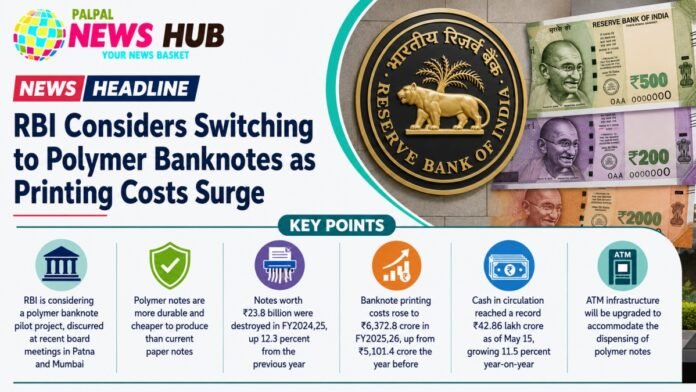
Key Points
- RBI is considering a polymer banknote pilot project, discussed at recent board meetings in Patna and Mumbai
- Polymer notes are more durable and cheaper to produce than current paper notes
- Notes worth ₹23.8 billion were destroyed in FY2024-25, up 12.3 per cent from the previous year
- Banknote printing costs rose to ₹6,372.8 crore in FY2025,26, up from ₹5,101.4 crore the year before
- Cash in circulation reached a record ₹42.86 lakh crore as of May 15, growing 11.5 per cent year-on-year
- ATM infrastructure will be upgraded to accommodate the dispensing of polymer notes
The Reserve Bank of India is seriously evaluating a transition to polymer or plastic banknotes, a move that could mark one of the most significant changes to India’s physical currency in decades. According to media reports, the proposal was discussed in detail during the RBI’s last two board meetings, held in Patna and Mumbai, with a public pilot project expected to be launched in the near future.
The driving forces behind the consideration are straightforward: polymer notes last significantly longer than paper ones and cost less to produce, both factors that have become increasingly pressing as India’s currency destruction and printing bills continue to climb.
The Cost of Paper Notes Is Growing
Stark data back the financial case for polymer currency. During the financial year 2024,25, Indian banknotes worth approximately ₹23.8 billion were destroyed, representing a 12.3 per cent increase over the ₹21.24 billion destroyed the year before. The bulk of the destroyed notes were ₹500 and ₹100 denomination bills, the two most widely circulated denominations in everyday transactions.
The cost of replacing those notes is substantial. Banknote printing expenditure for FY2025,26 reached ₹6,372.8 crore, a significant jump from ₹5,101.4 crore in the previous year. Polymer notes, which are far more resistant to wear, moisture, and damage, are expected to reduce this recurring expenditure considerably by extending the usable life of each note in circulation.
Infrastructure to Be Upgraded
The RBI has acknowledged that a shift to polymer notes will require parallel upgrades to the country’s ATM network. India has made considerable progress in financial technology infrastructure in recent years, and the central bank is confident that the nation’s ATMs can be adapted to reliably dispense the new format of notes without significant disruption to the public.
Cash Demand Refuses to Slow Down
Perhaps the most compelling argument for more durable currency is the relentless growth in cash demand. Despite India’s rapid and widely celebrated expansion in digital payments through platforms like UPI, demand for physical currency shows no sign of easing.
As of May 15, total cash in circulation had risen 11.5 per cent year-on-year to a record high of ₹42.86 lakh crore. The data points to a dual economy in which digital and physical transactions are both growing simultaneously rather than one displacing the other.
Small denomination notes, particularly ₹10 and ₹20 bills, remain in high demand, though they account for just 0.7 per cent and 0.8 percent of total cash in circulation respectively. Government efforts to encourage greater use of coins as a substitute for low-denomination notes have so far not delivered the expected uptake among the public.