




































Key Points
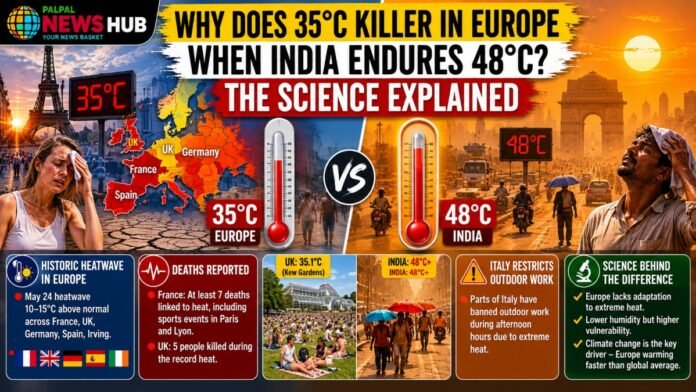
- A historic heatwave beginning May 24 has pushed temperatures 10 to 15 degrees Celsius above normal across Western Europe, breaking all-time May and springtime records in France, the UK, Germany, Spain, and Ireland.
- France has recorded at least seven deaths directly or indirectly linked to the heat, including fatalities during outdoor sports events in Paris and Lyon.
- The UK broke its all-time spring temperature record at Kew Gardens on May 25 at 34.8°C, only to break it again the next day at 35.1°C. Five people were killed during the event.
- Parts of Italy have imposed restrictions on outdoor work during afternoon hours.
- Scientists have identified climate change as the key driver, with Europe warming faster than the global average.
Much of Western Europe is facing an “unprecedented” heatwave for this time of year. France recorded its hottest May day ever, with the capital Paris notching up its first temperature above 30°C of the year on Saturday, and conditions described as a “heat dome” pressing down on the continent.
In Spain, the State Meteorological Agency warned that exceptionally high temperatures for this time of year will continue all week, with peaks expected to reach 38°C. Restrictions on outdoor work were imposed in parts of Italy, and beaches in southwest France filled earlier than usual as people sought relief.
The UN has called the heatwave a “brutal reminder” of climate change, with scientists noting that Europe is warming faster than the global average, making such events more frequent and more severe.
The Body’s Heat Tolerance
The first and most fundamental reason lies in biology. Europe is historically a cold continent, and the bodies of people who have lived there for generations are physiologically better adapted to cold than to heat. Extended exposure to high temperatures triggers heat exhaustion, dehydration, and cardiovascular stress in populations that have little natural or conditioned tolerance for sustained warmth. This is why a temperature of even 35°C can pose a genuine threat to life.
Homes Built for Winter, Not Summer
Most European homes were constructed over centuries with a single objective: keeping out the cold. Thick stone walls and compact, enclosed layouts are highly effective at retaining warmth in winter. However, those same properties turn homes into heat traps in summer. This was evident in Cornwall, England, where a record-breaking “tropical night” saw temperatures fail to fall below 21.4°C, meaning residents received no overnight respite. With heat locked inside and no relief after dark, bodies are denied the recovery time they need.
Air Conditioning is Rare
Unlike India’s urban centers, where air conditioning has become a standard fixture, most European homes and older buildings lack it entirely. Even where units exist, high electricity costs discourage regular use. During a heatwave, this absence of cooling infrastructure becomes a critical vulnerability, leaving vulnerable people, particularly the elderly, with no means of escape from the heat.
No Nighttime Recovery
Experts consistently identify prolonged heat as the deadliest pattern. A single hot day is manageable for most people, but when high temperatures persist for days and nights without relief, the body begins to break down from accumulated fatigue. A lack of sleep combined with cardiovascular strain places dangerous pressure on the heart and brain, conditions that can turn fatal, especially for older adults.
The Isolation Factor
In France, many of those affected were encountered alone, with people far from family and neighbors who might otherwise check on them. A large proportion of Europe’s population, spanning working professionals to retired elderly individuals, lives alone. In such circumstances, conditions like heatstroke or severe dehydration can deteriorate into medical emergencies without anyone nearby to intervene or raise an alarm.
Climate Change: The Bigger Picture
Scientists have confirmed that human-driven climate change is amplifying these extremes directly, with heatwaves in Europe growing both more frequent and more intense with each passing year. What was once a rare summer anomaly is becoming an increasingly predictable feature of the European calendar, and the continent’s infrastructure, architecture, and public health systems are struggling to keep pace.