

































Key Points
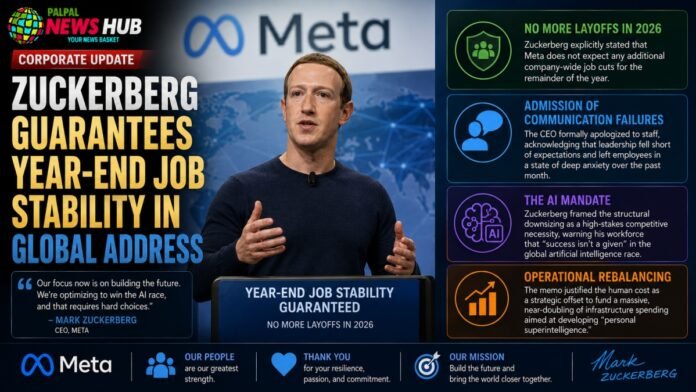
- No More Layoffs in 2026: Zuckerberg explicitly stated that Meta does not expect any additional company-wide job cuts for the remainder of the year, attempting to stabilize internal morale.
- Admission of Communication Failures: The CEO formally apologized to staff, acknowledging that leadership fell short of expectations and left employees in a state of deep anxiety over the past month.
- The AI Mandate: Zuckerberg framed the structural downsizing as a high-stakes competitive necessity, warning his workforce that “success isn,t a given” in the global artificial intelligence race.
- Operational Rebalancing: The memo justified the human cost as a strategic offset to fund a massive, near-doubling of infrastructure spending aimed at developing “personal superintelligence.”
Following weeks of severe internal anxiety, Meta Platforms CEO Mark Zuckerberg issued a highly calculated, direct address to the company,s remaining 78,000 employees. The internal memo, sent early Wednesday morning as rolling layoff notifications began hitting local offices, represents a firm effort by the chief executive to restore institutional stability.
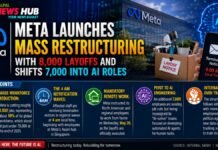
The address comes immediately after Meta finalized a sweeping 10% reduction in its global workforce, an operational downsize that eliminated 14,000 total positions through 8,000 individual terminations and the systemic cancellation of 6,000 open job requisitions.
Acknowledging the heavy emotional toll of the day, Zuckerberg wrote:
“It’s always sad to say goodbye to people who have contributed to our mission and to building this company. I feel the weight of that, and I’m spending a lot of time making sure we manage this as well as possible.”
Two Critical Promises to the Surviving Workforce
The core of Zuckerberg’s address focused heavily on repairing internal sentiment, which had plummeted to historic lows after initial restructuring signals leaked to the media on April 23. To counter widespread fear that a secondary wave of terminations was imminent, Zuckerberg delivered two explicit organizational commitments:
- An Ironclad Stability Guarantee: Zuckerberg provided what many employees viewed as a rare, definitive safety net in the current tech climate, stating, “I want to be clear that we do not expect other company-wide layoffs this year.”
- A Pledge for Transparency: Addressing the widespread frustration of staff members who spent a month operating in a holding pattern, the CEO took personal accountability for the structural gridlock. “I also want to acknowledge that we haven’t been as clear as we aspire to be in our communication, and that’s one area I want to make sure we improve,” he conceded.
Framing the High-Stakes Race for ‘Superintelligence’
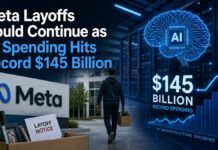
While the address aimed to offer emotional reassurance, Zuckerberg was unflinching regarding the competitive pressures dictating Meta,s aggressive shift in payroll allocation. He explicitly tied the human workforce reductions to the company’s monumental infrastructure pivot, which has seen its 2026 capital expenditure guidance balloon to between $125 billion and $145 billion to bankroll custom computer silicon, new data centers, and raw GPU procurement under Meta Superintelligence Labs.
Zuckerberg made it clear that legacy achievements in social networking do not guarantee dominance in the next technological epoch. “Success isn’t a given,” he warned the ranks. “AI is the most consequential technology of our lifetimes.”
A Leaner Blueprint for the Future
Closing out his global address, Zuckerberg reasserted his long-held corporate philosophy of “efficiency,” arguing that flatter management structures and smaller, highly synchronized engineering pods will ultimately yield superior product output. Despite the immediate friction caused by moving 7,000 existing workers into mandatory AI roles, the CEO maintained that Meta possesses the unique structural design to lead the sector.
“I’m confident in what we’re all building together,” Zuckerberg concluded in his sign-off. “We are one of the few companies positioned to help define the future. Meta has the talent, the infrastructure, the apps, the distribution, and the business model. We have a lot of work ahead, but what’s on the other side is going to be extraordinary.”