

































Key Points
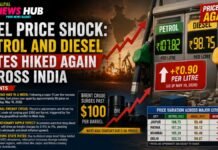
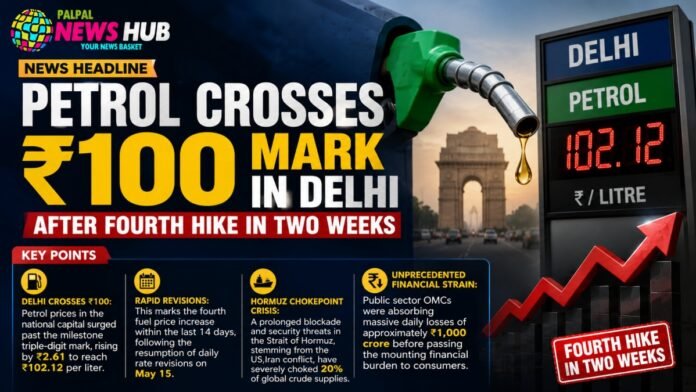
- Delhi Crosses ₹100: Petrol prices in the national capital surged past the milestone triple-digit mark, rising by ₹2.61 to reach ₹102.12 per liter.
- Rapid Revisions: This marks the fourth fuel price increase within the last 14 days, following the resumption of daily rate revisions on May 15.
- Hormuz Chokepoint Crisis: A prolonged blockade and security threats in the Strait of Hormuz, stemming from the US-Iran conflict, have severely choked 20% of global crude supplies.
- Unprecedented Financial Strain: Public sector OMCs were absorbing massive daily losses of approximately ₹1,000 crore before passing the mounting financial burden to consumers.
The underlying trigger for the sudden spike at Indian fuel stations lies squarely in international markets. Ongoing geopolitical hostilities between the United States and Iran have effectively restricted commercial shipping transit through the Strait of Hormuz, the planet’s primary maritime energy corridor. With nearly a fifth of global crude shipments and significant liquefied natural gas (LNG) volumes bottlenecked or forced into costly rerouting, Brent crude prices have steadily consolidated well above the $100 per,barrel mark.
Reflecting on the volatility, Sushma Rawat, Director (Exploration) at ONGC, observed that market movements are tied tightly to geopolitical diplomatic signals. According to Rawat, prices dip whenever there is an indication of a peace accord, but spike backward immediately when no clear solution materializes. Rawat defended the timing of the hikes, pointing out that the government and state firms successfully shielded consumers via a 76-day retail price freeze. However, with OMCs absorbing massive under recoveries of nearly ₹1,000 crore per day, continuing the subsidy became financially unsustainable.
Metropolitan Breakdown: Price Records Shattered
Because retail fuel pricing is subject to varying state levies and local Value Added Tax (VAT) structures, the final cost at the pump shows substantial regional variation. The newest revision has pushed fuel rates to historic highs across major Indian metros, heavily stressing metropolitan commuter budgets.
Metropolitan & Regional Breakdown: Price Records Shattered
| City | Petrol Price (Per Liter) | Price Increase | Diesel Price (Per Liter) | Price Increase |
|---|---|---|---|---|
| Bhopal | ₹114.54 | +₹2.83 | ₹99.64 | +₹2.79 |
| Kolkata | ₹113.51 | +₹2.87 | ₹99.82 | +₹2.80 |
| Mumbai | ₹111.21 | +₹2.72 | ₹97.83 | +₹2.81 |
| Chennai | ₹107.77 | +₹2.46 | ₹99.55 | +₹2.57 |
| Delhi | ₹102.12 | +₹2.61 | ₹95.20 | +₹2.71 |
Note on State Variations: The steeper fuel prices recorded in cities like Bhopal and Kolkata compared to the national capital are directly driven by higher local Value Added Tax (VAT) structures and state-specific transportation cesses applied to petroleum products.
Import Reliance and the Macroeconomic Ripple
India relies heavily on external energy corridors, importing roughly 85% of its total crude requirements to feed domestic refineries. Industry experts highlight that the impact on the broader Indian economy is amplified further by a weakening Indian rupee against the US dollar, which automatically drives up the net landing cost of oil barrels.
Industry Insight: Sukhmal Kumar Jain, former Marketing Director at BPCL, confirmed that public sector oil companies are operating under massive under recoveries due to the gap between surging import costs and domestic retail recovery. While India’s strategic diversification of crude supplies away from the Middle East has successfully kept domestic refineries running at full capacity without throughput cuts, the financial weight of the raw global price spike remains unavoidable.
Though a tentative ceasefire framework was initiated in early April, shipping activity in the Persian Gulf remains severely depressed compared to baseline levels. If diplomatic negotiations over shipping lanes and regional stability stall further, industry analysts warn that additional rounds of retail price hikes will be required to keep OMCs financially viable.