



































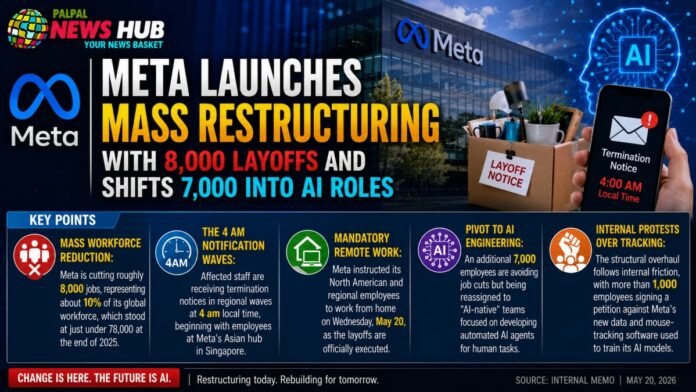
Key Points
- Mass Workforce Reduction: Meta is cutting roughly 8,000 jobs, representing about 10% of its global workforce, which stood at just under 78,000 at the end of 2025.
- The 4 AM Notification Waves: Affected staff are receiving termination notices in regional waves at 4 am local time, beginning with employees at Meta’s Asian hub in Singapore.
- Mandatory Remote Work: Meta instructed its North American and regional employees to work from home on Wednesday, May 20, as the layoffs are officially executed.
- Pivot to AI Engineering: An additional 7,000 employees are avoiding job cuts but being reassigned to “AI-native” teams focused on developing automated AI agents for human tasks.
- Internal Protests Over Tracking: The structural overhaul follows internal friction, with more than 1,000 employees signing a petition against Meta’s new data and mouse-tracking software used to train its AI models.
A sweeping wave of job terminations took effect at Meta Platforms today, Wednesday, May 20, as the tech giant begins laying off approximately 8,000 workers globally. In an effort to manage the logistical and emotional fallout of the mass cuts, Meta’s leadership explicitly instructed employees in North America and affected regions to work from home.
The notifications are being sent out across three distinct regional waves, catching many workers off guard in the early hours. Staff members at Meta’s primary Asian headquarters in Singapore were among the first to see their access revoked, receiving termination emails landing in their inboxes as early as 4 am local time. Similar automated notifications are hitting employees across Europe and the United States as their respective time zones hit the early morning mark.
Flattening Management to Fund an AI Future
The job cuts are hitting Meta’s engineering and product teams hardest, though company insiders warn that additional corporate restructuring could trigger more downsizing later this year. The workforce reduction sits inside a monumental pivot toward infrastructure, with Meta guiding its 2026 capital expenditure to a staggering $125 billion to $145 billion, prioritizing data centers, custom silicon chips, and massive model training.
In a leaked internal memo, Meta’s Chief People Officer, Janelle Gale, framed the cuts as a move toward a leaner, faster organizational model rather than a simple cost-saving measure.
“We’re now at the stage where many orgs can operate with a flatter structure, with smaller teams of pods, cohorts that can move faster and with more ownership,” Gale wrote. “We believe this will make us more productive and make the work more rewarding.”
While 8,000 roles are being wiped out permanently, Meta is also eliminating 6,000 open job listings it had been actively trying to fill. However, not all affected personnel are being cast out, as Meta is simultaneously migrating roughly 7,000 remaining workers into specialized internal divisions, including Applied AI Engineering and the Agent Transformation Accelerator XFN, to build autonomous AI agents designed to execute everyday corporate functions.
Keystroke Tracking and Employee Backlash
Addressing the workforce, Meta CEO Mark Zuckerberg stated that direct AI automation is not the underlying culprit behind the immediate layoffs, though he acknowledged that generative AI has enabled down-sized teams to operate with much greater efficiency.
The restructuring follows a highly tense month within the company. Employees have openly protested a new, highly controversial piece of internal mouse-tracking and keystroke software implemented by management. More than 1,000 Meta workers signed an active internal petition pushing back against the program, raising severe privacy concerns. Zuckerberg sought to de-escalate the anger by clarifying that human managers are not directly watching employees through their screens, explaining that the data is abstracted to train underlying AI models on how humans utilize enterprise workflows.
For those leaving the company, Meta is offering a standard tech severance package. Terminated workers in the United States will receive 16 weeks of base compensation, alongside two additional weeks of pay for every year of service, bundled with extended healthcare coverage and career transition services.