



































Key Points
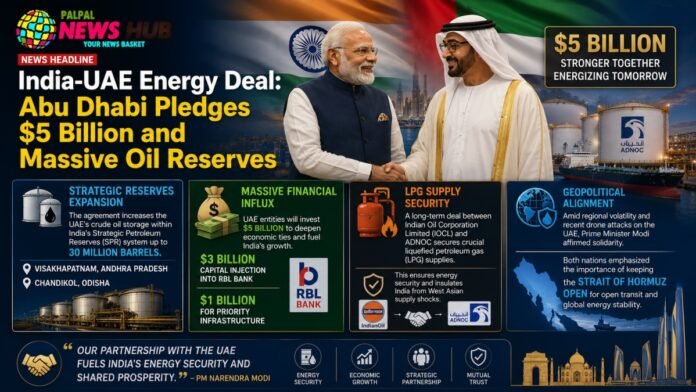
- Strategic Reserves Expansion: The agreement increases the UAE’s crude oil storage within India’s Strategic Petroleum Reserves system up to 30 million barrels, utilizing facilities in Visakhapatnam and Chandikol.
- Massive Financial Influx: UAE entities will invest 5 billion dollars, including a 3 billion dollar capital injection into RBL Bank and 1 billion dollars for priority infrastructure.
- LPG Supply Security: A long-term deal between Indian Oil Corporation Limited and ADNOC secures crucial liquefied petroleum gas supplies, insulating India from West Asian supply shocks.
- Geopolitical Alignment: Amid regional volatility and recent drone attacks on the UAE, Prime Minister Modi affirmed solidarity and emphasized keeping the Strait of Hormuz open for open transit.
Amid escalating tensions across West Asia, India and the United Arab Emirates concluded a historic comprehensive energy and security defense framework during Prime Minister Narendra Modi’s high-profile diplomatic stopover in Abu Dhabi. Meeting with UAE President Sheikh Mohammed bin Zayed Al Nahyan, the two leaders fortified bilateral ties against global energy disruptions, particularly highlighting the necessity of maintaining unimpeded maritime navigation through the Strait of Hormuz.
The visit, which marked the first leg of Prime Minister Modi’s wider global tour before he proceeded to the Netherlands, comes on the heels of recent regional security challenges. Expressing absolute solidarity, Modi noted that India stands shoulder to shoulder with the UAE, emphasizing that secure maritime trade routes remain vital to global economic, energy, and food security.
Upgrading the Strategic Petroleum Reserve Formula
The cornerstone of the newly finalized energy security matrix is a landmark Strategic Collaboration Agreement signed between Indian Strategic Petroleum Reserves Limited, known as ISPRL, and the Abu Dhabi National Oil Company, or ADNOC. This pact dramatically scales up the UAE’s existing storage commitment from a previous baseline of 5 million barrels to an unprecedented 30 million barrels of crude oil.
Under the approved framework, ADNOC will utilize India’s strategic underground facilities located in Visakhapatnam, Andhra Pradesh, alongside a newly proposed storage development site in Chandikol, Odisha. The agreement also charts a reciprocal pathway for India, exploring potential crude oil reserves to be held at Fujairah in the UAE, alongside joint strategic gas reserves on Indian soil. Currently, the UAE serves as India’s fourth-largest source of crude oil, meeting approximately 11 percent of national requirements, and this buffer establishes a powerful safeguard against supply chain vulnerabilities.
Securing Long-Term Cooking Gas and Maritime Infrastructure
In tandem with crude reserves, a secondary, highly critical agreement was operationalized between Indian Oil Corporation Limited and ADNOC regarding long-term Liquefied Petroleum Gas, or LPG, supplies. As the UAE already serves as India’s single largest source of LPG, catering to nearly 40 percent of total domestic consumption, this long-term pact guarantees price and supply stability for millions of Indian households.
Furthermore, the bilateral cooperation expanded directly into maritime logistics, featuring a signed agreement between Cochin Shipyard Limited and Dubai’s Drydocks World to build an advanced ship-repair cluster at Vadinar, Gujarat. This initiative, launched under the Maritime Development Fund Scheme, positions India as a primary hub for specialized offshore fabrication and skilled maritime workforce training.
High-Impact 5 Billion Dollar Financial Influx
Beyond the resource matrix, Abu Dhabi announced a massive 5 billion dollar economic investment package specifically structured to inject capital into India’s financial and infrastructure ecosystems. The financial package is distributed across three definitive economic components:
- Emirates NBD Injection: The prominent Dubai-based banking group will invest 3 billion dollars directly into India’s RBL Bank, reinforcing bilateral institutional finance.
- Infrastructure Allocation: The Abu Dhabi Investment Authority, or ADIA, in collaboration with the National Infrastructure and Investment Fund of India, will deploy 1 billion dollars into priority domestic infrastructure projects.
- Corporate Capital: The International Holding Company of the UAE will direct 1 billion dollars to Sammaan Capital, bolstering specialized finance and commercial integration.
Ministry of External Affairs representatives stated that these multi-layered capital commitments underscore the UAE’s sustained, long-term confidence in India’s growth trajectory. As Prime Minister Modi continues his diplomatic tour, this redefined Indo-UAE partnership successfully updates and strengthens India’s strategic defense, tech infrastructure, and economic resilience against a highly volatile global landscape.