
































Key Takeaways
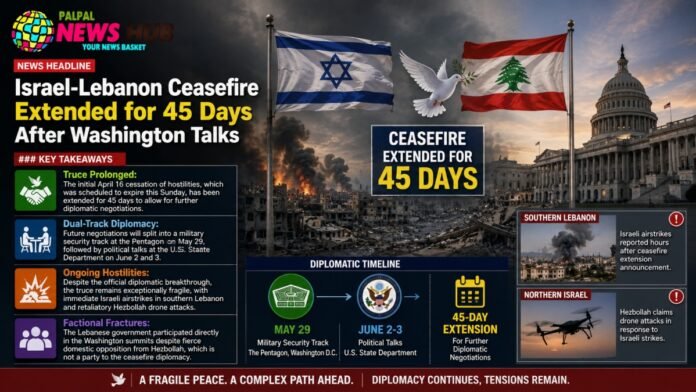
- Truce Prolonged: The initial April 16 cessation of hostilities, which was scheduled to expire this Sunday, has been extended for 45 days to allow for further diplomatic negotiations.
- Dual-Track Diplomacy: Future negotiations will split into a military security track at the Pentagon on May 29, followed by political talks at the U.S. State Department on June 2 and 3.
- Ongoing Hostilities: Despite the official diplomatic breakthrough, the truce remains exceptionally fragile, with immediate Israeli airstrikes in southern Lebanon and retaliatory Hezbollah drone attacks.
- Factional Fractures: The Lebanese government participated directly in the Washington summits despite fierce domestic opposition from Hezbollah, which is not a party to the ceasefire diplomacy.
High-level peace negotiations mediated by the United States have concluded with a significant diplomatic breakthrough, as diplomatic envoys from Israel and Lebanon officially agreed to extend their bilateral ceasefire for an additional 45 days. The temporary cessation of hostilities, which originally went into effect on April 16, 2026, under an initiative led by U.S. President Donald Trump, was on the verge of expiring this weekend.
Announcing the successful conclusion of the two-day summit, U.S. State Department spokesperson Tommy Pigott characterized the talks as highly productive. Washington remains hopeful that the extended timeline will pave the way toward a permanent political settlement, advancing a framework for lasting peace, mutual recognition of national sovereignty, and stabilized security along the shared border.
Direct Engagement Amid Deep Factional Divisions
The latest rounds of meetings in Washington marked one of the highest-level direct engagements between Israeli and Lebanese officials in decades, uniquely incorporating top military and security personnel from both nations. However, the direct diplomacy has highlighted steep political rifts. The Lebanese government moved forward with the negotiations despite explicit condemnation from Hezbollah, the powerful Iranian-backed political and militant group.
During the face-to-face sessions, both delegations navigated fundamentally opposing objectives:
- Lebanon’s Mandate: Prioritizing an immediate, permanent end to the conflict to protect ordinary citizens, stabilize crumbling civilian infrastructure, and reinforce formal state institutions.
- Israel’s Prerequisite: Demanding the absolute disarmament of Hezbollah and its withdrawal from border zones as a non-negotiable prerequisite for any long-term treaty.
Volatile Conflict History and Humanitarian Crisis
The devastating border war erupted on March 2, 2026, when Hezbollah launched a massive missile barrage into northern Israel, occurring just three days into a broader regional conflict involving the U.S., Israel, and Iran. In retaliation, the Israel Defense Forces launched sweeping aerial bombardment campaigns and intense ground operations throughout southern Lebanon. This rapid escalation triggered an acute humanitarian crisis, displacing approximately 1.2 million people in Lebanon and leaving heavy casualties on both sides.
A Shaky Truce Tested by Immediate Violations
While diplomats in Washington finalized the 45-day extension, conditions on the ground remain deeply alarming. Because Hezbollah is not an official signatory to the ceasefire framework, localized violence has persisted. Moments after the extension was announced, a series of military actions shattered the fragile calm:
Recent Ground Updates:
- Hanuf Strike: An Israeli airstrike hit a center linked to the Islamic Health Committee in the southern town of Hanuf, killing six people, including three paramedics.
- Tyre Bombardment: Following localized civilian evacuation orders, the Israeli Air Force launched targeted strikes across the southern port city of Tyre, wounding at least 37 people.
- Kiryat Shmona Barrage: Hezbollah retaliated by deploying first-person-view drones and rockets against Israeli military barracks in the northern border city of Kiryat Shmona.
According to military statements, the IDF has eliminated over 220 Hezbollah fighters over the past week alone. Concurrently, the IDF reported additional combat fatalities, bringing the total number of Israeli soldiers killed in border clashes since early March to 19.
Blueprint for Permanent Settlement Tracks
To transition this temporary window into a sustainable, long-term peace agreement, facilitators have organized a rigorous, dual-track negotiation blueprint for the upcoming weeks:
| Target Date (2026) | Negotiation Track | Hosting Venue | Primary Objective |
|---|---|---|---|
| May 29 | Security Track | The Pentagon | Military delegations, border demarcations, and troop positioning |
| June 2–3 | Political Track | U.S. Department of State | Sovereignty treaties, governance frameworks, and regional diplomacy |
While the Lebanese delegation views the 45-day extension as vital breathing room for its population, Israel’s Ambassador to the U.S., Yechiel Leiter, described the discussions as frank and constructive, noting that while there will be inevitable negotiation setbacks, the potential for ultimate success is high. Meanwhile, broader regional dynamics remain complex, as Iran has publicly stated that a complete cessation of Israeli operations in Lebanon remains a fundamental condition before any wider regional accord can be struck with the Trump administration.